


I. This “Launch Event” Was Really a Signal
On March 4, 2026, Apple’s quietly staged “Special Apple Experience” across New York, London, and Shanghai was, at its core, an invite-only media hands-on session. No Tim Cook on stage. No global livestream. Nothing remotely surprising.
The headline products — the M5 MacBook lineup (including the entry-level MacBook Neo), a refreshed M4 iPad Air, and the mid-range iPhone 17e — had already been telegraphed through press releases weeks earlier. The specs were real improvements: Neural Engine 3.5–4x faster, snappier local AI responses. But structurally, this was incremental iteration in its most classic form. Better screens, faster chips, a handful of new AI micro-features. No model breakthroughs, no benchmark dominance, no moment of genuine surprise.
The real meaning of this event wasn’t what Apple showed. It was what Apple didn’t show.
Apple kept things deliberately low-key because it knows exactly where it stands: on the AI narrative, it doesn’t yet have anything worth centering a stage around. That restraint is itself a signal — the real cards are still face-down, waiting to be flipped in the second half of the year.
The question is: how strong are those cards, really?
II. The Gemini Deal: Not a Partnership — a Confession
To understand Apple’s current AI strategy, you have to be honest about what the Gemini agreement actually means.
The January 2026 joint statement was explicit: future Siri personalization, multimodal understanding, and complex task execution will rely primarily on Gemini’s cloud capabilities, wrapped in Apple’s Private Cloud Compute for privacy. This isn’t a “partnership” in any conventional sense. Gemini is the primary backend. The OpenAI/ChatGPT agreement remains, but has been clearly downgraded to a supporting role — a fallback for complex queries, nothing more.
Many people’s first question is: why Google, and not OpenAI or Anthropic?
There are several layers worth unpacking.
Layer one: weaponizing regulatory pressure. Apple and Google already have a $20B+/year search traffic deal currently under DOJ antitrust scrutiny. By deepening their AI cooperation at this exact moment, Apple is signaling to regulators — “we’re ecosystem partners, not a monopoly” — while simultaneously using Google’s legal exposure as future negotiating leverage. Apple is turning Google’s problem into its own crowbar.
Layer two: technology realism. Gemini 3 is, in enterprise deployment terms, one of the most reliably capable models for multimodal tasks, long-context reasoning, and tool use. Apple doesn’t need the most cutting-edge research model — it needs something stable, customizable, and latency-controllable in production. On those criteria, Gemini is a better fit than GPT-o series models.
Layer three: data sovereignty as a non-negotiable. Apple cannot hand raw user data to any third party without destroying the trust its entire business model is built on. The Gemini integration is structured as model weight licensing plus private cloud fine-tuning — not data flowing back to Google. This architecture is technically viable, but extraordinarily complex to engineer, which explains the repeated delays.
Strip away the strategic framing, and what’s left is a straightforward admission:
Apple does not have a world-class foundation model of its own.
Its internally developed models remain in the small-to-mid parameter range, trailing Gemini, GPT, and Claude by a wide margin on public benchmarks. Apple chose Gemini not out of laziness, but out of necessity — it has structural deficits in training data scale, compute infrastructure, and the engineering depth required to build a hybrid on-device/cloud architecture from scratch. Those gaps can’t be closed in a single product cycle.
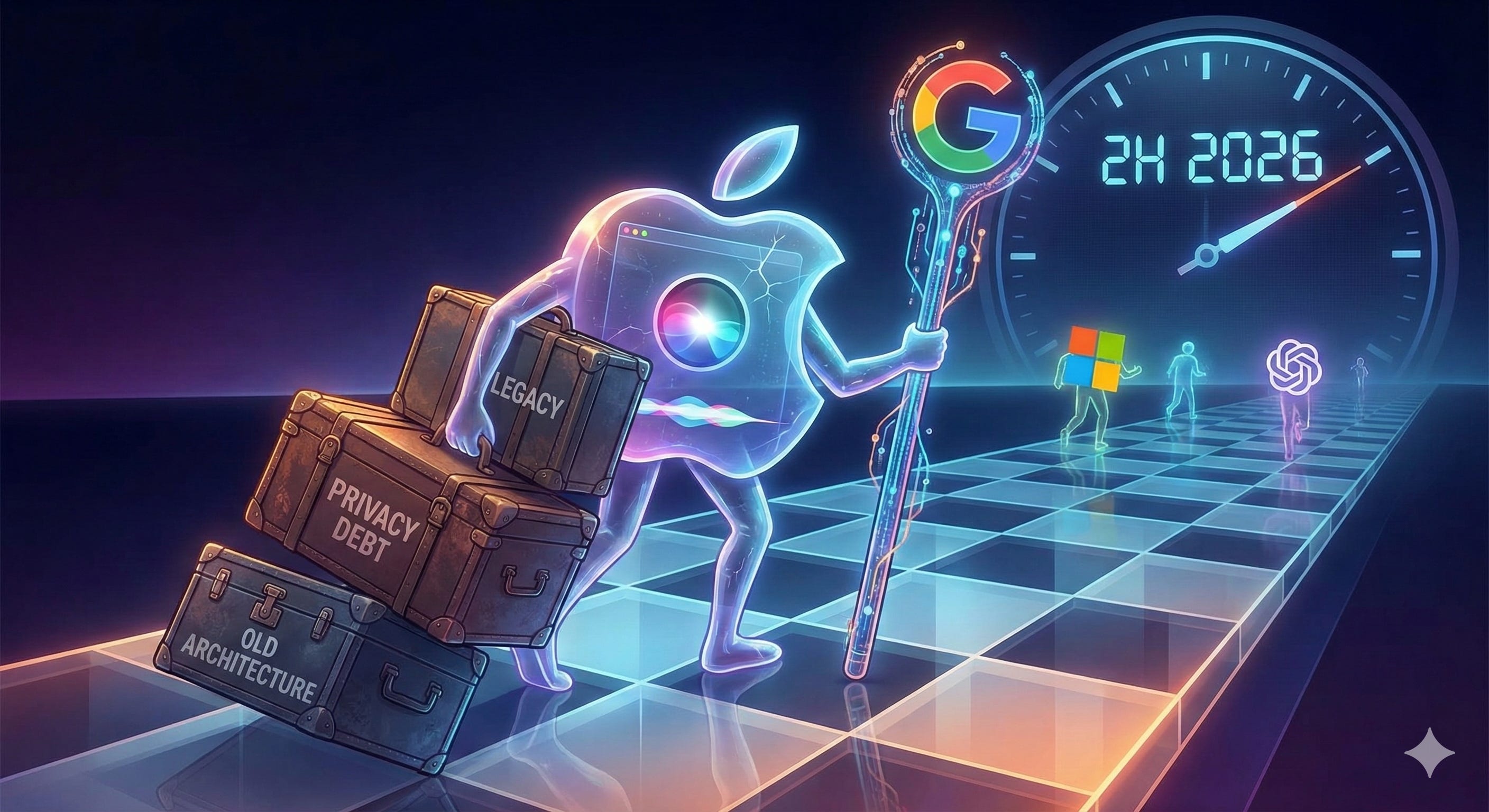
III. The Original Sin of Siri — Why This Bet Is Genuinely Dangerous
Apple has wagered everything on Siri.
An assistant born in 2011. Fifteen years old. Mocked by users across the globe for over a decade.
Before analyzing the risks, it’s worth understanding why Siri ended up here. This wasn’t any single failure — it was organizational structure determining technological fate.
After Apple acquired Siri, it was quickly fragmented across divisions: speech recognition to one team, natural language understanding to another, device integration to a third. No single executive had the cross-functional authority to drive a fundamental architectural overhaul. Every iOS major release required Siri to maintain backward compatibility with all its existing capabilities — meaning technical debt accumulated with each cycle, and no one ever had the mandate to tear it down and rebuild. Meanwhile, Apple’s uncompromising privacy commitments objectively prevented Siri from training on the continuous stream of user interaction data that made Google Assistant steadily better. A principled starting point systematically capped the technical ceiling.
This is Siri’s original sin — not that the technology was bad, but that organizational design and strategic positioning conspired to prevent it from ever becoming good.
Now Apple wants to graft Gemini — the most powerful available external model — onto this historically compromised product, and use the combination to deliver “Screen Awareness,” multi-step task execution, and zero-data-upload privacy guarantees simultaneously. The risks stack in at least three dimensions.
Risk one: the gravitational pull of brand perception.
Users’ mental model of Siri has crystallized into “useless.” This isn’t just sentiment — it’s a cognitive science reality. When a brand has generated strong negative expectations, even a product that objectively performs at 80 gets perceived at 60, because the expectation ceiling has already been set by history.
Even with Gemini underneath, if early experiences show any latency, any context loss, any misfire — users will attribute it instantly to “Apple’s Siri failing again.” The inertia of brand perception moves far slower than technology can. What Apple may actually need isn’t a better Siri — it needs a new name, a new visual identity, a new interaction paradigm for its AI entry point. It chose not to do that. That conservative choice carries its own cost.
Risk two: the engineering complexity of the hybrid architecture.
Gemini’s strength doesn’t translate automatically into Siri’s improvement. Apple must build, on top of Gemini’s API, a complete layer of on-device semantic parsing, private cloud routing, fine-tuning pipelines, and millisecond-level context synchronization between edge and cloud.
“Screen Awareness” — understanding what page you’re on, what you’re doing in an app, and reasoning about it in real time — requires the device to perform live semantic analysis and sync that context with the cloud model in near-real-time. The engineering complexity here is not incremental. It approaches the difficulty of designing a real-time operating system from scratch.
The repeated delays — from Spring 2025, to 2026, then from iOS 26.4 to “later in the year” — have already demonstrated that the actual engineering difficulty vastly exceeded internal projections. And each quarter of delay raises the bar: the longer Apple waits, the higher users’ baseline expectations become, and the larger the “surprise” has to be to generate positive momentum.
Risk three: geopolitical fragility of external dependency.
This is the most underappreciated risk, and potentially the most existential.
Google is a direct competitor. The current arrangement looks mutually beneficial — but extend the horizon three years. If users come to perceive Gemini as “the brain behind Siri,” Google accrues brand halo from Apple’s distribution. When the contract comes up for renegotiation, Google holds every piece of leverage: price increases, restrictions on customization rights, demands for greater data access. Apple’s switching costs will be enormous, because by then its entire inference architecture will have been rebuilt around Gemini’s APIs.
The China dimension compounds this. Gemini is unavailable in China. Apple will need to integrate domestic models — Baidu’s ERNIE, Alibaba’s Qwen, or others — meaning “Siri” runs on completely different brains in different markets. A consistent, unified AI experience across Apple’s global ecosystem becomes structurally impossible. This is a persistent fracture in Apple’s core narrative of seamless ecosystem coherence.
IV. The Competitive Landscape: Apple’s Window Is Closing
Place Apple in the broader competitive picture, and the position looks more precarious.
Google is self-contained in a way no other competitor is: search distribution plus Android scale plus Gemini self-development form a self-reinforcing triangle. It doesn’t have to ask where AI capability comes from — it is the source. Gemini in Android is already deployed across billions of devices. Behavioral habits are forming.
Microsoft has cracked enterprise AI monetization. Copilot is embedded in Teams, Office, and Azure — a closed loop that generates recurring revenue regardless of consumer AI dynamics. The consumer side remains weak, but the enterprise cash flow is more than enough to sustain continued R&D burn.
Samsung is more dangerous than most forecasts credit. Galaxy AI is moving aggressively down-market, pushing AI features into mid-range devices — directly threatening iPhone 17e’s positioning. For users who want AI-capable hardware without paying Apple’s premium, Samsung is becoming the rational choice.
OpenAI has ambitions far beyond being an API supplier. Its consumer applications — ChatGPT App, Advanced Voice Mode — are competing directly for the “default AI interface” position in users’ minds, bypassing hardware manufacturers entirely. If OpenAI successfully captures that mental model, Siri becomes a system-level utility rather than a core AI experience. That’s a profound repositioning loss for Apple.
In this landscape, Apple’s only genuinely durable advantages are the 2.5 billion active devices in its hardware ecosystem and users’ deep-seated trust in its privacy commitments. But both of these are defensive assets, not offensive ones. In a competition that rewards continuous learning, continuous data accumulation, and continuous model improvement, defensive moats erode faster than traditional product cycles would suggest.
V. Wall Street’s Hidden Tab
Apple’s AI struggles are already affecting its capital market narrative in ways that don’t always make headlines.
Between 2021 and 2023, Apple’s valuation premium rested substantially on the “hardware-plus-services flywheel” story — stable iPhone upgrade cycles, high-margin services growth, steadily improving gross margins. That logic held. But its implicit assumption was that Apple’s ecosystem lock-in was strong enough to prevent meaningful user attrition even if AI capabilities lagged.
That assumption is being eroded, slowly but measurably.
Three data points matter here. First, Apple’s market share in China has declined continuously since 2024, while Huawei and Xiaomi have integrated AI features faster than most Western analysts expected. Second, developer adoption of Apple Intelligence APIs is running significantly below comparable Android AI API adoption rates — developers are voting with their integration priorities. Third, App Store services revenue growth has decelerated, partly because AI productivity tools are increasingly cross-platform by design (Notion AI, Perplexity, and equivalents don’t need Apple-specific integration).
This isn’t a crisis. It’s slow bleeding. For a company with a $3+ trillion market cap, slow bleeding is harder to address than an acute shock — there’s no clear crisis point that creates the urgency for fundamental strategic rethinking.
VI. Why the “Apple Always Wins Late” Argument Breaks Down Here
Every Apple defender reaches for the same historical playbook: Apple is never first, but always redefines the category.
The iPod wasn’t the first MP3 player. The iPhone wasn’t the first smartphone. The iPad wasn’t the first tablet. The Apple Watch wasn’t the first smartwatch. And yet each became the category standard.
The logic is historically accurate. But there’s a structural difference this time that the argument glosses over.
In every prior “Apple wins late” scenario, Apple was entering a hardware category in its early phase — products that were functional but rough around the edges, where superior design, ecosystem integration, and pricing strategy could establish durable consumer preference. The critical feature of hardware competition is that you can build it right once, then let the ecosystem compound around it.
AI is not hardware. It is a continuously evolving software capability. Models require ongoing training. Inference requires ongoing optimization. User feedback needs to continuously feed back into improvement. This is a race with no finish line, not a product you launch and let mature.
Apple’s historical playbook was to enter during a product category’s maturation phase and deliver a better experience. But AI may never have a maturation phase — or by the time it does, Google and Microsoft will have locked in the defining positions. What Apple is facing this time is exactly the kind of competition it has historically been least equipped to win: a war of attrition that cannot be resolved by a single hardware breakthrough.
VII. Second Half 2026: Four Scenarios
Scenario A — Siri’s Resurrection (probability: ~20%)
The Campos version of Siri ships in iOS 26’s fall release: sub-500ms response latency, 85%+ task completion rates, privacy promises genuinely honored, 2.5 billion devices activated as AI endpoints overnight. The developer ecosystem rapidly follows. Siri becomes the highest-monetization-efficiency AI distribution channel in consumer tech. Apple reframes the narrative around “privacy-first AI,” and rewrites the competitive map.
This scenario requires not just technical success but narrative success — press, users, and developers buying in simultaneously. Apple has done it before. But brand rehabilitation in AI is an order of magnitude harder than in consumer hardware.
Scenario B — Partial Success, Gradual Chase (probability: ~35%)
The Campos Siri ships with genuinely useful performance in a handful of scenarios — calendar-email coordination, some in-app command execution — but remains unstable at the edges. Media coverage splits. Core users don’t defect in meaningful numbers, but there’s no new momentum. Apple settles into an “AI adequate” comfort zone, sustaining margins through hardware premium while quietly funding a long-duration internal model program.
This is the most probable scenario, and the least interesting result. Apple doesn’t lose. But it doesn’t win either.
Scenario C — Another Delay, Narrative Collapse (probability: ~30%)
Core features in iOS 26’s fall release are scaled back again. “Screen Awareness” and complex multi-step execution slip to 2027. Media coverage consolidates around “Apple AI strategy failing.” Institutional investors reduce AI premium in valuation models. Developer community frustration reaches visible levels. Wall Street begins repricing Apple not as an “AI company” but as premium consumer electronics — a meaningful multiple compression.
Scenario D — Black Swan, Forced Strategic Pivot (probability: ~15%)
The Gemini agreement encounters severe friction — regulatory action, data security breakdown, negotiation collapse. Apple is forced to find a new foundation model partner or accelerate self-development under duress. The most chaotic scenario near-term, but also the one most likely to force genuine strategic clarity — the way external shocks have historically snapped Apple into more decisive moves.
VIII. Our Verdict
Our current position: cautious, not bearish — and watching closely.
The skepticism is structural. Apple is fighting a kind of war it has historically never won: a war of attrition requiring continuous compute investment, a continuous data flywheel, and continuous model iteration. Its current strategy is using someone else’s weapon to fight its own battle — and the trigger isn’t in its own hands.
The reason we won’t go bearish: Apple has a deeply underappreciated variable in its favor — user inertia compounded by ecosystem lock-in.
Among 2.5 billion active Apple devices, the switching cost for most users isn’t just the price of a new phone. It’s the family photo library. The health data history. The iCloud document archive. The Watch. The AirPods. The full stack of interlocking dependencies. Unless the AI experience gap grows large enough that users decide all of that is worth abandoning, defection rates will lag pessimistic projections significantly.
That buys Apple time. But not unlimited time.
The second half of 2026 is a genuine inflection point — not a metaphor. If Siri fails to make a qualitative leap in this window, Apple misses the current AI upgrade cycle’s incremental growth. The next window opens against stronger competitors, more sophisticated users, and a higher baseline of expectations.
Apple’s greatest historical skill has been making the impossible real — slowly, quietly, through the compounding force of hardware quality and ecosystem depth — precisely when no one believed it could.
But this time, the clock doesn’t wait.
Second half of 2026. That’s when we find out.