


Broadcom is evolving from a diversified chip supplier into the behind-the-scenes “kingmaker” of the global AI computing architecture. While Nvidia maintains dominance in general-purpose GPUs, Broadcom has built a formidable secondary moat through custom ASICs (Application-Specific Integrated Circuits) and ultra-scale Ethernet switching technology.
The Architecture Shift: From General GPUs to Custom ASICs
During the AI infrastructure wave of 2025-2026, the core logic has shifted from merely “acquiring chips” to “Performance-per-watt.” As model sizes surpass trillions of parameters, the power deficit of general-purpose GPUs in specific inference and training workloads has become increasingly apparent.
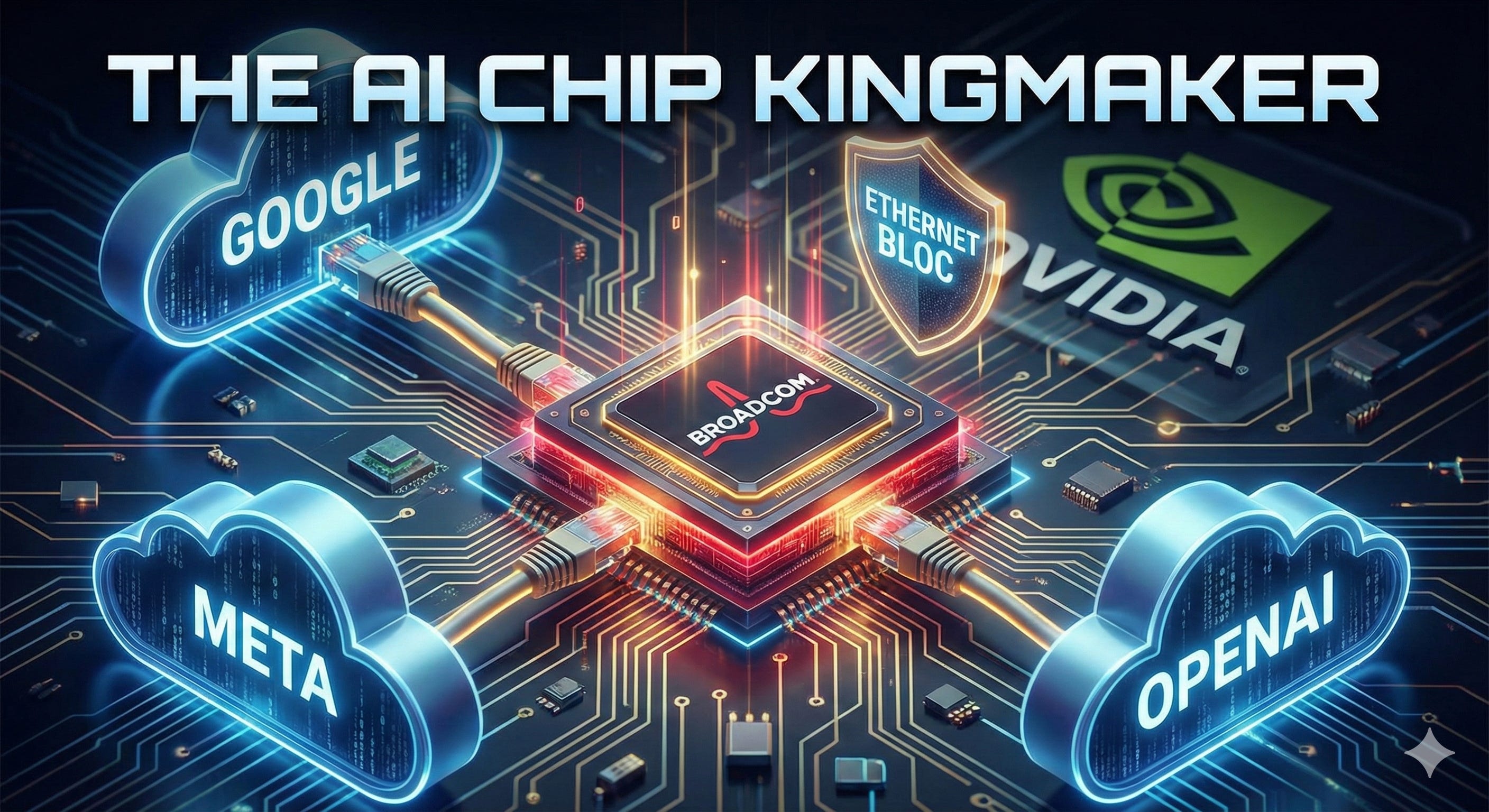
With a 70% to 80% global market share in the ASIC field, Broadcom has become the partner of choice for giants like Google, Meta, OpenAI, and ByteDance. Compared to Nvidia’s H/B series general-purpose cards, custom silicon can strip away redundant graphics rendering modules and focus purely on tensor cores, delivering higher throughput at the same power consumption. Currently, Alphabet plans to invest up to $180 billion in capital expenditures in 2026, a significant portion of which flows into TPU v6 and v7—chips designed in collaboration with Broadcom. Anthropic has also confirmed it will expand its use of Google Cloud TPUs to 1 million units in 2026, involving tens of billions of dollars.
Hidden Strategic Maneuvers: The Five-XPU Customer Strategy
Broadcom CEO Hock Tan revealed in a recent earnings call that the company has secured five major custom AI chip customers. Beyond long-term partners Google and Meta, OpenAI has reportedly listed Broadcom as its manufacturing and architectural partner for its in-house chips under “Project Titan,” a deal involving 10 GW of power capacity and a potential value of $100 billion. Furthermore, Broadcom secured a “fifth XPU customer” with a billion-dollar order, rumored by market analysts to be either Apple or xAI.
The underlying logic of this strategy is Vertical Integration & Anti-lock-in. By using Broadcom’s custom chips, hyperscalers can not only reduce Total Cost of Ownership (TCO) by over 30% but, more importantly, break free from the hardware and software hardware-software bundling of Nvidia’s CUDA ecosystem. Broadcom provides more than just chip logic; it provides industry-leading SerDes interface IP and advanced packaging coordination (TSMC CoWoS), making it the ultimate “arms dealer” for giants seeking to “de-Nvidia” their AI hardware race.
Technical Bottlenecks and the Ethernet Bloc
When AI clusters reach scales of 100,000 or even 1 million GPUs/XPUs, the bottleneck is no longer raw computation—it is Networking. Nvidia relies on its proprietary InfiniBand technology to maintain a closed ecosystem, whereas Broadcom has collaborated with Arista to build the “Ethernet Bloc.”
Broadcom’s Tomahawk 6 switching chips (102.4 Tbps) and Jericho3-AI routers have become the backbone for building million-node GPU clusters. Its proprietary “Cognitive Routing” technology can improve congestion response speeds by 10,000 times. This open standard not only reduces the complexity of network expansion but also aligns with US data center requirements for supply chain resilience. Q1 2026 financial forecasts show Broadcom’s AI backlog has surged to $73 billion, with networking chips representing a rapidly expanding share.
Short-Term & Long-Term Impact
Short-Term Impact: As OpenAI’s custom chips begin large-scale delivery in the second half of 2026, Broadcom’s AI revenue is expected to double, breaking the $40 billion mark. Although the lower gross margins of the ASIC business (approx. 50%-55%) may dilute overall corporate margins, the massive free cash flow generated has already driven a 15th consecutive year of dividend growth.
Long-Term Impact: Broadcom is redefining the competitive boundaries of AI semiconductors. If the “Agentic AI” revolution fails to yield expected commercial returns by late 2026, the market frenzy for general-purpose GPUs may cool. However, Broadcom, with its deeply integrated custom agreements and foundational network infrastructure, will possess stronger anti-cyclical resilience than pure chip distributors.