


Frontier-model leadership has changed hands twice in roughly four years. Looking back from August 2026: ChatGPT defined the category from day one. Claude got distinctly better to use over the course of 2025. Anthropic’s advantage peaked in the first quarter of 2026. And ChatGPT has been closing the gap ever since April.
Today, ChatGPT has caught up with Claude on agentic work and coding, and Anthropic’s edge is now confined to the most complex, long-horizon engineering tasks — the ones that stretch across dozens of turns. Meanwhile, OpenAI is more willing to take raw, unstructured material and use reasoning to connect fields that don’t obviously relate to each other — but it pays for that boldness with a higher hallucination rate. That looks less like one model being categorically stronger than the other, and more like two different bets on model behavior. What actually decides these contests was never some blanket judgment about “whose model scores higher.” It comes down to specific tasks, and to who can keep delivering intelligence steadily and reliably within the real constraints of compute, cost, and user scale. That’s what this piece tries to reconstruct along a timeline: what actually changed, each time the lead changed hands.
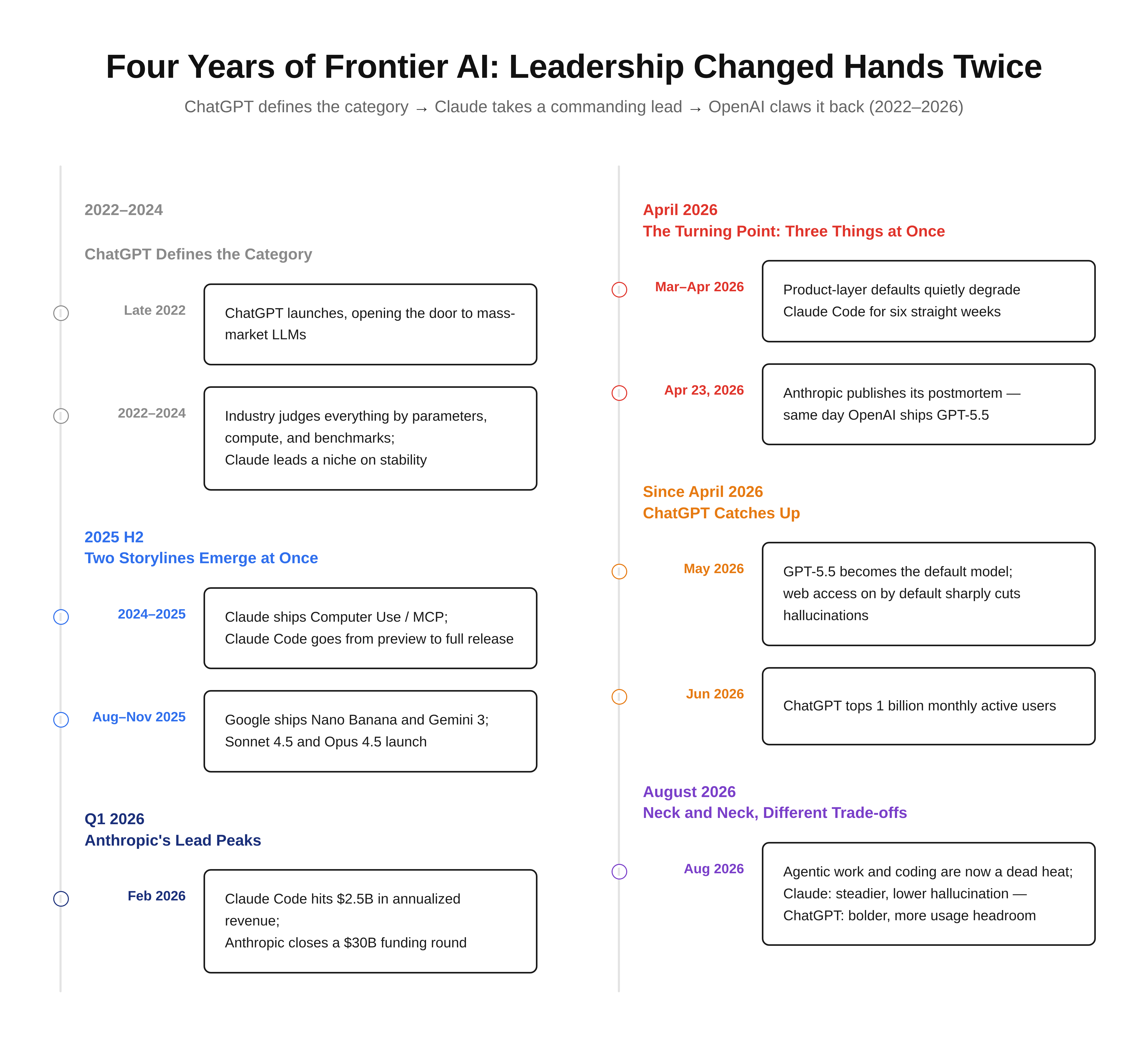
2022–2024: ChatGPT Defined the Category
ChatGPT was the on-ramp that brought large language models to a mass audience in late 2022. OpenAI’s advantage started with sheer scale: it folded chat, writing, coding, images, voice, search, and file handling into a single mass-market product, one piece at a time, and built the broadest brand recognition in the industry almost overnight. Its goal was a single entry point that covered as many tasks as possible — and at the time, almost nothing else came close.
For those two years, the industry had a simple story for everything: more parameters, bigger training runs, higher benchmark scores — therefore smarter models, therefore better products. That story basically held up while ChatGPT had the stage to itself, because almost no other variable was in play.
What Anthropic was doing at the time looked like a niche pursuit. Claude’s most distinctive early trait wasn’t a longer feature list — it was stability: long context, long-form writing, and reliability on complex, constraint-heavy coding tasks. It was more inclined to preserve material the user had provided, less likely to compress or rewrite content on its own initiative, and quicker to stick with a task instead of bailing out early. None of that read as a selling point back then; plenty of people found it overly restrained.
Second Half of 2025: Two Storylines Emerge at the Same Time
In the second half of 2025, two storylines worth remembering surfaced almost simultaneously: Anthropic’s breakthrough in coding, and Google’s breakthrough in multimodal. They would later lead to very different places.
The first storyline: Anthropic’s path from coding to agents. This story is often dated to the launch of Claude Code, but it actually starts earlier. From mid-2024 onward, Claude was already the default model in a large share of third-party coding tools; computer use in October and MCP in November were already turning the idea of letting a model act on the outside world into actual infrastructure. Claude Code itself only appeared as a research preview in February 2025 and shipped formally in May, but the real expansion came in the second half of the year: Sonnet 4.5 in September, a web version and sandbox in October, Opus 4.5 in November, and by November Claude Code’s annualized revenue had crossed $1 billion, spreading over the holidays to plenty of users who’d never written a line of code.
Why did the breakthrough happen in coding rather than somewhere else? The key is that agents and coding overlap on a single point: verification. The hard part of agentic work was never whether the model could call a tool — it’s whether the model can tell if the step it just took was right or wrong. Without verification, every extra step just compounds the error. And of all tasks, coding is the cheapest to verify: code runs, compilers throw errors, tests pass or fail, and error messages become the input for the next step. Verification is close to free, the outcome is unambiguous, and failure is instantly retryable. That’s what let the loop of “act → observe → correct → act again” actually run for the first time. Anthropic’s breakthrough happened here largely because it trained that loop into a usable working method first, inside the domain where verification is cheapest.
This was also a shift in the basic unit of work itself. Early generative AI operated one answer at a time: take in a question, put language together, produce something that looks complete as fast as possible. Complex tasks were routinely squeezed into a single pass — the model might understand the goal without ever really going through search, verification, correction, and retry. Agentic work replaced that unit with a loop: understand the goal, break the task down, take action, observe the result, revise the plan, keep going. A lot of what users experienced as the model “getting smarter” actually came from it being willing — and permitted — to take a few more steps.
The other half of the advantage came from giving the model more room to work in and staying more faithful to the user’s content. Output limits were never just about how long an answer could be: under a tight budget, a system will start summarizing, trimming, and restructuring on its own, and can quietly turn “just fix the formatting” into “rewrite the content while I’m at it.” That doesn’t necessarily mean the model failed to understand the instruction — there’s a whole layer of product control sitting between the model and the user: system prompts, instruction priority, task routing, compression strategy, default editing style, context management, and output post-processing. The base model can understand “don’t change the content” and still have that overridden by a higher-priority product default. Claude’s approach at the time was to give the model more room to work in, and to give more weight to boundaries the user had explicitly set.
None of this came for free. Every round of planning, search, tool calls, verification, and retries means more tokens, longer context, and more inference-time compute. The same base model, asked to produce two thousand words in one shot versus running continuously across dozens of turns with repeated checks, ends up behaving like two different models, and not equally smart ones. There’s a precondition here that’s easy to skip past: at the time, Anthropic could afford it. Its user base was small and concentrated among developers and enterprises willing to pay for results, which made it viable to pour heavy compute into a single task. OpenAI faced an entirely different situation — the same approach, multiplied by a far larger user base. It didn’t go down that road at the time, and while that was partly a strategic call, compute constraints were probably just as important a reason.
OpenAI wasn’t short on tools during this same period. Search, code execution, Deep Research, Operator, Codex, and more all showed up one after another, but for a long stretch they behaved more like separate modes: users had to decide for themselves when to search, when to analyze a file, when to run code, and manually hand off between different ways of working. That produced a seemingly odd situation — OpenAI had the bigger front door and the broader tool coverage, yet Claude looked more like an actual worker on many complex jobs. The gap wasn’t in the number of tools; it was in whether the model was allowed to keep working.
The second storyline: Google’s breakthrough in multimodal. Focusing only on the first two companies misses the one that actually stole the show in the second half of 2025. In August, Google’s image model Nano Banana quickly became the most widely used image-generation tool of the moment; in November, Gemini 3 launched with a natively multimodal architecture that unified text, image, video, and audio understanding and generation in a single model, and paired with Veo’s video capability, Google built the most complete multimodal stack that existed at the time. The market response was immediate and direct: by the end of November 2025, Alphabet’s stock was up more than 70% for the year, widely attributed to the reception of Gemini 3.
But on the agent side, Google still hasn’t produced anything at a comparable scale. It’s not short on models or platforms — Gemini 3 performs well on coding and terminal-operation benchmarks, and Antigravity is a fully built multi-agent development environment — yet nothing has emerged that developers treat as daily production infrastructure the way they treat Claude Code. Leading in multimodal never translated into leading at “getting the job actually done.”
There was another problem with the multimodal storyline that wasn’t obvious at the time and only became clear later: generative multimodal work — video especially — consumes far more compute per unit of output than text and code, while willingness to pay and revenue growth haven’t scaled to match. That mismatch was already taking shape in the second half of 2025, but it took until Q1 2026 to build up enough to become a public talking point, and it broke into the open in April — the shutdown of Sora, discussed later, is the most direct evidence of exactly that problem.
These two storylines are worth remembering side by side: one turned verifiability into a working method, the other turned perception and generation into a general-purpose capability. They didn’t head in the same direction — and it’s still far too early to say which bet was right.
Q1 2026: Anthropic’s Lead Peaks
By the first quarter of 2026, the returns on this approach arrived all at once. Claude Code’s annualized revenue went from $500 million in September 2025 to $2.5 billion in February 2026, then to $8 billion by May. Anthropic’s overall annualized revenue hit $14 billion in February, alongside a $30 billion funding round; that figure kept getting revised upward from there — an official April statement put it at “over $30 billion,” and unofficial estimates by July put it in the $60–$70 billion range. That’s mentioned here only as evidence of how high the peak got, not as something to dig into. Among developers and heavy knowledge workers, “use Claude for anything complicated” had become close to the default consensus.
What underpinned this lead wasn’t that “Claude was smarter across every dimension” — it was that Anthropic had been first to fully operationalize a working method inside a domain that could actually be verified. Coding has a rare form of external feedback: code runs, compilers throw errors, tests can judge outcomes, and changes can be iterated on repeatedly — the model doesn’t have to rely entirely on its own judgment about right and wrong, because the environment keeps supplying evidence. What gets trained under those conditions is transferable: how to break a goal into steps, when to call which tool, how to retry after a failure, and how to still remember the objective dozens of turns later.
Once the method took shape, it started extending outward. Browser operation, file handling, research, and general knowledge work all ran on essentially the same loop, just with the compiler swapped out for some other source of feedback. So what users felt as “Claude got smarter” in Q1 was, more precisely, “Claude’s working method matured” — it learned how to get things done in coding first, then carried that way of working elsewhere.
Whether that spillover fully holds up is still an open question. Open-ended knowledge tasks have no compiler and no single correct answer. An agent can easily take a wrong judgment, break it into ten steps, and then execute that wrong task more efficiently.
The peak was also where the pressure started. Once the user base scaled up quickly, the platform ran into real trade-offs among compute, latency, cost, and service capacity for the first time. And the very things that had made Claude feel smarter — longer thinking, more tool calls, bigger context, wider output — were exactly the costs that scale linearly with the number of users.
April 2026: Three Things Happen at Once — A Turning Point
Pulling back a bit, April 2026 wasn’t just a turning point for Anthropic — three unrelated things happened at nearly the same time. The first was Anthropic’s own product-layer incident, from mass user reports through official acknowledgment and fixes, all concentrated within this one month. The second was a deliberate contraction-and-pivot at OpenAI — it announced Sora’s shutdown on March 24, took it offline on April 26, and redirected the freed-up compute toward Codex and agentic work (more on this below). The third was at Google, where a multimodal bet over a year in the making still hadn’t paid off: users and developers could feel that this path had burned enormous compute without producing a killer application on the axis that actually decides whether something is “good to use” — agentic work. At the same time, Gemini itself started drawing frequent complaints about instability from early April onward, a perception later confirmed by Bloomberg reporting in July, which reported that Gemini 3.5 Pro was “months behind” and quoted Google employees admitting outright, “we fell behind.” The three events had entirely different causes, yet together they made April the single most information-dense month of these four years.
Start with the fastest-moving and most dramatic of the three — Anthropic’s own episode. Starting in March 2026, Claude Code users began reporting en masse that the model had “gotten dumber”: it couldn’t hold onto context, it repeated steps it had already completed, tool selection became inconsistent, and it hit usage limits noticeably faster. The complaints ran for six weeks before Anthropic responded.
On April 23, Anthropic published an engineering postmortem acknowledging that quality had genuinely degraded across three product lines — Claude Code, the Agent SDK, and Cowork — between March 4 and April 20, and pointed to three causes: on March 4, Claude Code’s default reasoning effort was turned down from high to medium, on the reasoning that high effort sometimes caused excessive waiting and burned through usage limits faster; a caching optimization shipped on March 26, meant to clear out thinking blocks from idle sessions, instead ended up wiping the model’s own reasoning history on every subsequent turn; and a system prompt that shipped alongside Opus 4.7 on April 16, aimed at trimming verbosity, capped tool calls at 25 words apart and final answers at 100 words. All three fixes landed together in v2.1.116 on April 20, and on April 23 Anthropic reset usage limits for every subscriber.
Community evidence arrived ahead of the official conclusion. An engineering director at AMD audited 6,852 Claude Code session logs and 230,000 tool calls and found the model had shifted from “research first, then act” to “act first,” with reasoning depth dropping noticeably; a third-party benchmark found one Opus variant’s accuracy fall from 83.3% to 68.3%.
What makes this episode a genuine turning point, rather than a footnote, is that none of the three causes touched the model’s weights — the API and the underlying weights were untouched; every change happened outside the model, at the product layer: reasoning effort, context retention, output length. The same set of weights delivered noticeably lower intelligence purely because of three default settings. It turned something that had previously only been arguable on the basis of “vibes” into a documented, officially acknowledged fact.
Whether things returned to peak form after the fix is a much messier question. Officially, all three issues were resolved by April 20, and Opus 4.8 shipped on May 28 — but plenty of long-time users still feel it never fully came back. At least four explanations can hold simultaneously: first, some product-layer issues weren’t fully cleaned up — an abnormal token-count blowup in a later version was still being reported by developers as of mid-May; second, usage limits changed shape — in May Anthropic doubled the five-hour limit and removed the peak-hour reduction, but didn’t raise the weekly cap to match, so heavy users started hitting the weekly wall even sooner, and in June automated usage was split out into separate billing; third, as of June there’s no public, benchmark-backed evidence of model-level regression in non-coding capabilities like writing — essentially all of the confirmed 2026 quality regressions were concentrated in the Claude Code product line; and fourth, the frame of reference shifted — competitors were improving quickly over the same period, so standing still amounted to a relative decline. These four explanations aren’t mutually exclusive, and the last one has only grown more important since April.
Now the second event, on OpenAI’s side. On March 24, 2026, OpenAI announced it was shutting down Sora, its video-generation product; the web and app versions went offline on April 26, with the API scheduled to follow on September 24. Public reporting attributes this almost entirely to economics — Sora’s daily operating cost ran into the millions of dollars while cumulative product revenue sat at only a few million, and video generation happens to be both the most compute-intensive category per unit of output and one of the least reliable in terms of willingness to pay, which made it the first thing sacrificed when compute needed to be reallocated. What’s actually worth remembering isn’t the shutdown itself, but where that freed-up compute went: that same month, OpenAI shipped GPT-5.5, explicitly designed to “act continuously, call tools, browse the web, and check its own work,” and Codex became a heavily invested-in product over this same stretch. In other words, OpenAI made a compute reallocation in April — pulling back from consumer multimodal and concentrating on agentic work and coding — and that shift went on to play a key role in ChatGPT’s catch-up over the rest of the year.
Since April 2026: ChatGPT Catches Up
An easy-to-miss coincidence: on the same day Anthropic published its postmortem — April 23 — OpenAI shipped GPT-5.5, the first fully retrained base model since GPT-4.5, explicitly designed around the ability to “act continuously, call tools, browse the web, and check its own work.” What changed about ChatGPT over the following months wasn’t the result of any single release; it was several variables moving forward at once.
Web access on by default. This is the single most important change, though it’s often treated as a minor feature. Search used to be something users had to opt into manually, and even when explicitly requested it wouldn’t always actually run; now the system judges on its own whether information might be stale and searches to check. The effect of that one switch went well beyond what you’d expect: the model used to suffer from serious “temporal hallucination” — permanently living at the moment its training data was cut off — and that’s now sharply reduced. More importantly, it can now check its own reasoning against retrieved evidence, which drags down content hallucination along with it. OpenAI’s own figures put the hallucination rate on a set of high-stakes medical, legal, and financial questions dropping from 18.7% to 8.9%; this version became the default model for every ChatGPT user on May 5.
One thing worth being precise about: this improvement mainly comes from tool grounding and self-checking, not from the weights themselves getting smarter. In independent benchmarks that don’t allow tool use — where the model has to answer purely from its own parameters — GPT-5.5’s hallucination rate on long-tail facts is still noticeably higher than Claude Opus 4.7’s. In other words, the reliability users experience is something the whole system delivers, not something the model possesses on its own. By the same logic, the fact that search used to default to off and was hard to trigger reliably was probably not a model limitation either — it was more likely a compute-and-latency trade-off.
More room for output. This mattered just as much. GPT-5.5 expanded the API context window to one million tokens and raised the maximum single output to 128,000 tokens, and its performance on long-range cross-referencing went from 36.6% to 74.0%. Situations that used to be common — the model clearly understood the material but couldn’t finish writing it out, got cut off mid-answer, or turned “just fix the formatting” into “rewrite the content while I’m at it” — became noticeably less frequent.
Work first, then organize the answer. Complex tasks stopped being reflexively compressed into a single pass. The model now leans toward understanding the goal, forming a plan, reading through material, calling tools, and verifying results before delivering the final answer. The answer users see may not be much longer, but the process behind it has grown substantially — the line between “answering” and “working” has started to blur.
Structural understanding of complex files. A large context window is not the same thing as genuinely understanding a long document. Working with long files requires, at minimum, the ability to hold the text, retrieve specific details, synthesize across pages, and understand structure — and when users are working through papers, reports, or complex PDFs, it’s usually that fourth capability they actually need: recognizing heading hierarchy, tables, images, footnotes, page relationships, and the overall argumentative structure of the document. Anthropic has always been strong on long-range retrieval, but on this particular kind of task, ChatGPT currently has a clear experiential edge — it’s better at treating a PDF as a structured whole rather than just a very long sequence of text. Put differently, what a model actually “sees” is never the raw file a user uploaded, but whatever internal representation the product system builds for it; context engineering and document representation have become their own competitive variable.
More respect for task boundaries. When a user asked for “just change the formatting, not the content,” ChatGPT used to often place its default instinct toward “improving the prose” above the explicit instruction; that kind of overreach is now noticeably rarer. Users don’t much care why — the intelligence that actually gets delivered has to include the ability to follow the stated goal. A highly capable model that quietly rewrites the task on its own isn’t the same thing as a high-quality working system.
Standing in August 2026
OpenAI and Anthropic are now neck and neck on agentic work and coding, but Anthropic still leads on the most complex, long-horizon tasks. ChatGPT’s execution on agentic and coding work now sits at roughly the same level as Claude’s; Anthropic’s edge survives only on the single hardest category of tasks — long-horizon engineering work that spans dozens of turns, involves messy state, requires repeated backtracking, and has shifting boundary conditions. The gap here doesn’t show up in single-step accuracy; it shows up in stability across a long chain — who loses the goal less often along the way, who’s less likely to run a wrong assumption all the way to the end. There’s public benchmark evidence behind this: on SWE-bench Pro, which requires fully resolving real repository issues, the latest Claude Opus 5 leads GPT-5.6 Sol 79.2% to 64.6% — a gap that has actually widened from the previous generation (Opus 4.8’s 69.2% versus GPT-5.5’s 58.6%) to 14.6 percentage points. On multi-file refactoring tasks touching five or more files — exactly the kind of task that tests “not losing the goal across a long chain” — third-party benchmarks also show Claude making fewer errors.
OpenAI currently has the edge at structuring raw material and using reasoning to connect unrelated domains. This isn’t about whether a model “understood” something — it’s a more specific capability: given a pile of unorganized, long-form material, can it proactively structure and present it; given two fields that look completely unrelated, can it use reasoning to actually connect them rather than just summarizing each one separately. ChatGPT is currently more likely to actually push that kind of analysis somewhere new, rather than just laying the material out. This looks more like a question of model behavior than of capability ceiling: Anthropic’s training approach — including constraints on output like Constitutional AI — likely makes Claude more conservative when facing uncertain cross-domain inference, less willing to take the leap of “connect it first, sort out the certainty later” without a high degree of confidence; OpenAI’s models are clearly more willing to take that risk.
That’s very likely paid for with a real cost: Claude’s hallucination rate is meaningfully lower. The flip side of the same model-behavior choice is hallucination rate — as mentioned earlier, in independent benchmarks that don’t allow tool use, GPT-5.5’s hallucination rate is still noticeably higher than Claude’s. Some evaluation firms put the gap at a fairly stark level: on the latest generation, comparing Claude Opus 5 against GPT-5.6 Sol, the former sits around 50% and the latter still close to 90% — Opus 5 is up from the previous generation’s roughly 36% (Opus 4.8), but still well ahead of GPT-5.6 Sol. “More willing to connect the dots” and “less likely to make things up” are very plausibly two sides of the same training orientation: OpenAI is trading a higher hallucination rate for stronger cross-domain connection; Anthropic is trading more conservative reasoning for a lower hallucination rate. Neither is categorically better — they’re two different risk appetites.
So the right approach today is to switch tools by task. The two companies represent genuinely different model behaviors: work that needs long-horizon execution, strict boundary compliance, content fidelity, and the lowest possible hallucination rate is safer with Claude; open-ended work that needs messy material structured and unrelated domains boldly connected tends to shine more with ChatGPT — at the cost of an extra fact-checking pass.
At the same price point, Anthropic and OpenAI are not giving you the same amount of usage. Looking purely at token consumption per task, the gap between the two is roughly fourfold — a fairly “clean” number from several third-party benchmarks run on the same tasks, though it actually understates what ordinary users feel. What gets complained about the most is how much usable time a given allowance actually translates into: plenty of long-time users report that Codex rarely hits its limit on the $200 tier, while Claude Max 20x, even after the May limit doubling, still regularly hits a wall within a week. There’s even a comparison circulating in developer communities that a $20 ChatGPT Plus subscription delivers roughly as much daily coding time as a $100 Claude Max 5x subscription — a gap of an entire pricing tier. In other words, “fourfold” only captures the task-level token-efficiency gap; the gap in usable allowance that users actually feel is very likely an order of magnitude, not just “a bit more expensive.” Anthropic’s core users are precisely the people who consume the most compute — and for the ones actually running their allowance to the limit, once a competitor offers more room to execute at the same price, the intelligence-delivery gap stops being purely a question of model capability and becomes a question of how much inference time a dollar actually buys.
Scale is a reality OpenAI has to reckon with. OpenAI committed early to the consumer path, and the results of that choice are clear by now: ChatGPT reached 900 million weekly active users and 50 million paid subscribers in February 2026; by June, the app was reported to have passed 1 billion monthly active users. Anthropic never went down that road — third-party estimates put Claude’s consumer monthly active users in the tens of millions, a figure Anthropic has never disclosed itself; what it does disclose is more than 300,000 enterprise customers. That gap directly shapes how each company handles compute: Anthropic’s user base is small and much of its compute is concentrated on coding — high-value, verifiable, and clearly worth paying for — so it can afford to spend heavily on a single task. OpenAI has to serve close to a billion daily users at once, the vast majority of whom don’t pay, so every time it raises the default reasoning effort, turns search on by default, or turns a single answer into multi-turn execution, that cost gets multiplied by an enormous base. That’s also the direct reason it keeps raising massive funding rounds to build out compute infrastructure: for OpenAI, compute isn’t a one-time training expense — it’s the precondition for whether the product can keep behaving the way it currently does. April’s shutdown of Sora was the most direct sacrifice made under exactly that trade-off.
Don’t underestimate Google. After Sora’s shutdown, OpenAI effectively pulled back on consumer multimodal; Anthropic never built multimodal generation in the first place — its models handle understanding, not generation. Right now, Google is the only company still fully pursuing multimodal end to end, and it has its own chips, data centers, and distribution channels; Gemini’s monthly active users were reported at roughly 900 million at Google’s 2026 developer conference. Multimodal looks today like a direction that’s been shoved aside by agentic work, but no one can say for certain how long that will hold — if agents ultimately need to actually see a screen, understand video, and understand audio to finish a job, today’s multimodal investment could become the main storyline all over again.
Closing Thoughts
Looking at these four years together, no single shift in leadership was decided purely by “whose model scored higher.” ChatGPT won the first round on sheer coverage. Claude won by being first to turn a verifiable working method into a habit inside coding, and by being willing to keep pouring compute into individual tasks. This round of ChatGPT’s comeback rests on defaulting to live web verification, loosening its output limits, and making “do the work first, then answer” the default behavior — and none of that, either, was a victory of the model weights themselves; it was a victory of product-layer choices. The most dramatic swing in the middle of this story proves the same point in reverse: three purely product-layer defaults were enough to make the exact same set of weights deliver noticeably lower intelligence.
What becomes clear across these four years is a handful of trade-offs bundled together — hard for any one company to hold all sides of at once. Anthropic is more stable on long-horizon agentic tasks, at the cost of buying less execution time per dollar. OpenAI is bolder at structuring material and connecting across domains, at the cost of a higher hallucination rate. Anthropic can afford to pour compute into a single task because its user base is small and concentrated among people willing to pay for results; OpenAI has to multiply the same move by close to a billion daily active users, which is exactly why shutting down Sora and redirecting compute to Codex weren’t optional strategic flourishes — they were forced choices. No single company holds all of these trade-offs at once.
Looking ahead, the real open question isn’t “who will win” — it’s a handful of more concrete things that can eventually be checked against reality: whether the verifiable method Anthropic built in coding can genuinely transfer to open-ended tasks with no compiler and no single right answer; whether OpenAI’s approach of lowering hallucination through tool grounding can hold up once compute gets tighter and it still has to keep subsidizing close to a billion free users; and whether Google’s long-delayed multimodal investment becomes the decisive variable again on the day agents genuinely need to “see the screen and understand the sound” to finish the job. Leadership has already changed hands twice in four years. These three questions will most likely determine when it changes hands again — and whether it keeps happening only between these two companies.