


External Loop Internal Loop Pure Financial Standalone Bet
In the space of fewer than ninety days, three of the world’s most closely watched AI companies completed back-to-back funding rounds of extraordinary scale. xAI closed a $20 billion Series E in January at a post-money valuation of roughly $230 billion. Anthropic followed in February with a $30 billion Series G at $380 billion post-money. OpenAI capped the sequence with a $110 billion raise, valuing the company at $730 billion pre-money — or approximately $840 billion post-money. Together, more than $160 billion changed hands in a single quarter.
The headline numbers, however, obscure a more interesting question: how much of that capital represents genuine new money, and how much is structured to flow right back to the investors who wrote the checks? In several of the largest deals, the same companies that are listed as investors are also the cloud providers, chip suppliers, and distribution partners to whom the AI companies have simultaneously committed billions in future spending.
This analysis examines each deal through the lens of what we call nominal capital versus real exposure — the gap between what an investor nominally commits and what it actually risks, net of commercial return flows. The framework has limits, which we explain as we go.
I A Framework: Four Types of Investors
To understand who is really taking risk in this funding boom, it helps to distinguish between nominal commitment — the amount an investor agrees to put in — and real net exposure — what remains at risk after accounting for commercial return flows. When an investor is also a major vendor or distribution partner to the company it just funded, those commercial relationships can substantially reduce its true economic stake.
Based on whether such return mechanisms exist, the investors in this funding cycle fall into four categories:
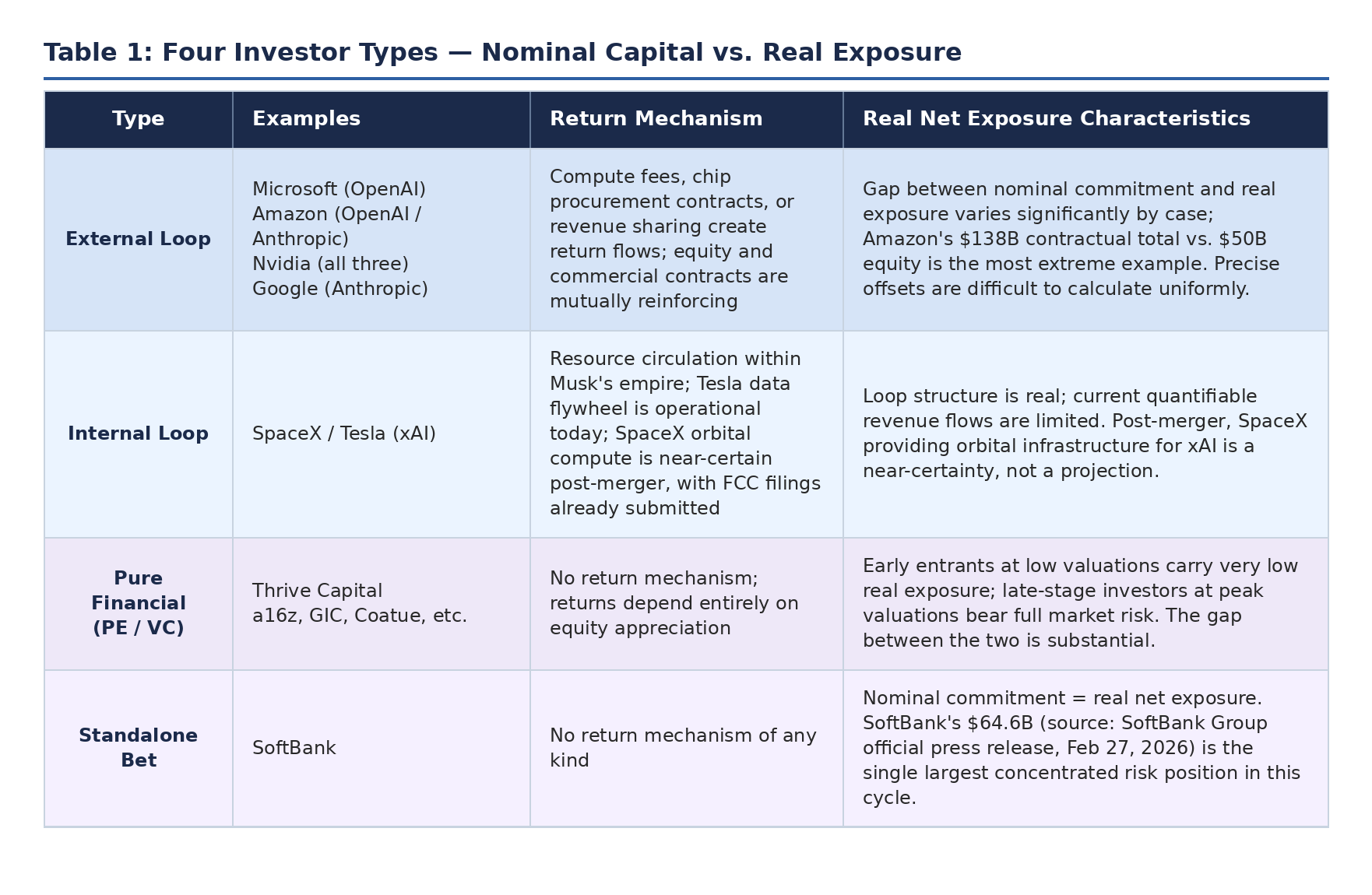
A note on the external loop category: the degree of return flow varies considerably across cases. Microsoft’s arrangement with OpenAI — involving Azure compute fees, revenue sharing, and a $2.5 trillion infrastructure commitment from OpenAI — represents a deeper and more durable loop than, say, Nvidia’s stake in Anthropic. The framework groups them together because the structural dynamic is the same; we discuss the individual cases in detail below.
II The Numbers at a Glance
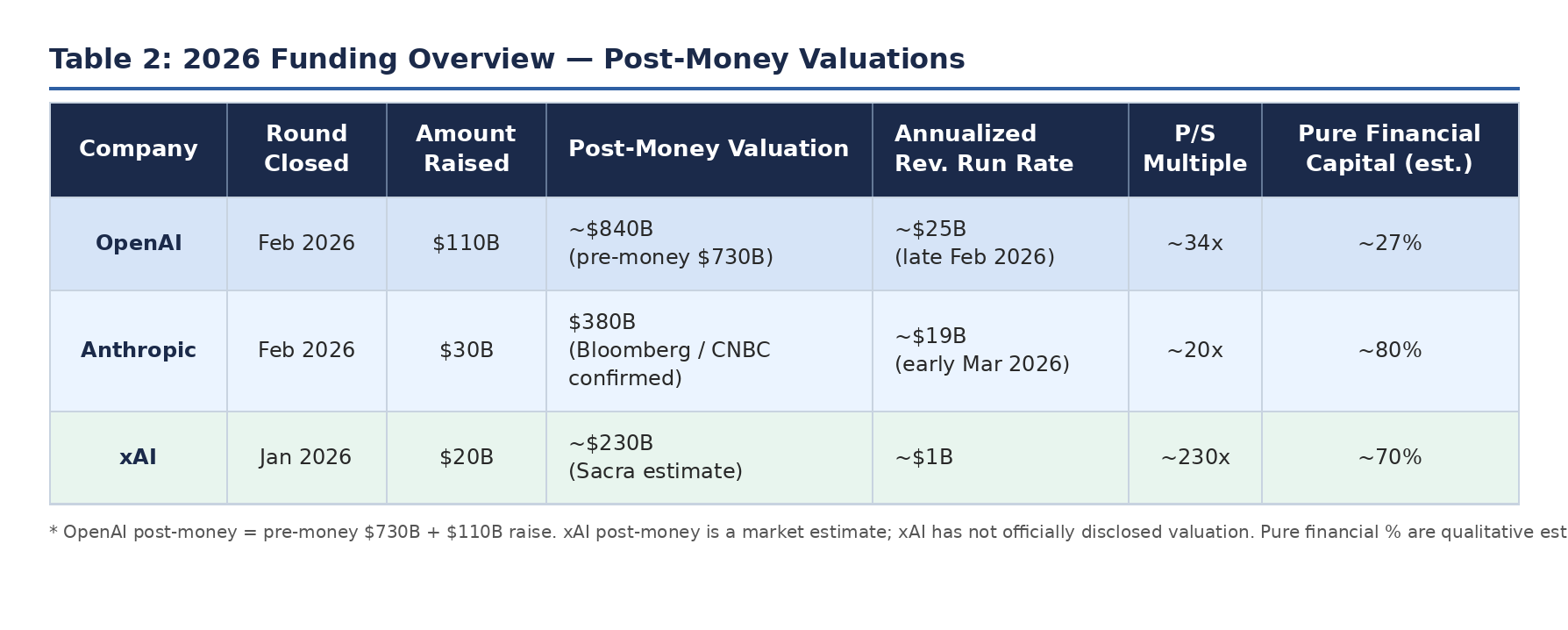
The three companies present starkly different pictures on the basic question of valuation versus revenue. OpenAI trades at roughly 34x its current annualized revenue run rate of approximately $25 billion (as of late February 2026). Anthropic, at $380 billion post-money, is valued at around 20x its run rate of approximately $19 billion (as of early March 2026, per Bloomberg) — the tightest multiple of the three, and the closest to what a traditional high-growth software company might command. xAI sits at a remarkable 230x: post-money valuation of roughly $230 billion against an annualized revenue run rate of around $1 billion. That multiple is essentially a pure bet on future trajectory, not a reflection of current business scale.
III OpenAI: Where the Gap Between Nominal and Real Is Widest
Breaking Down the $110 Billion Round
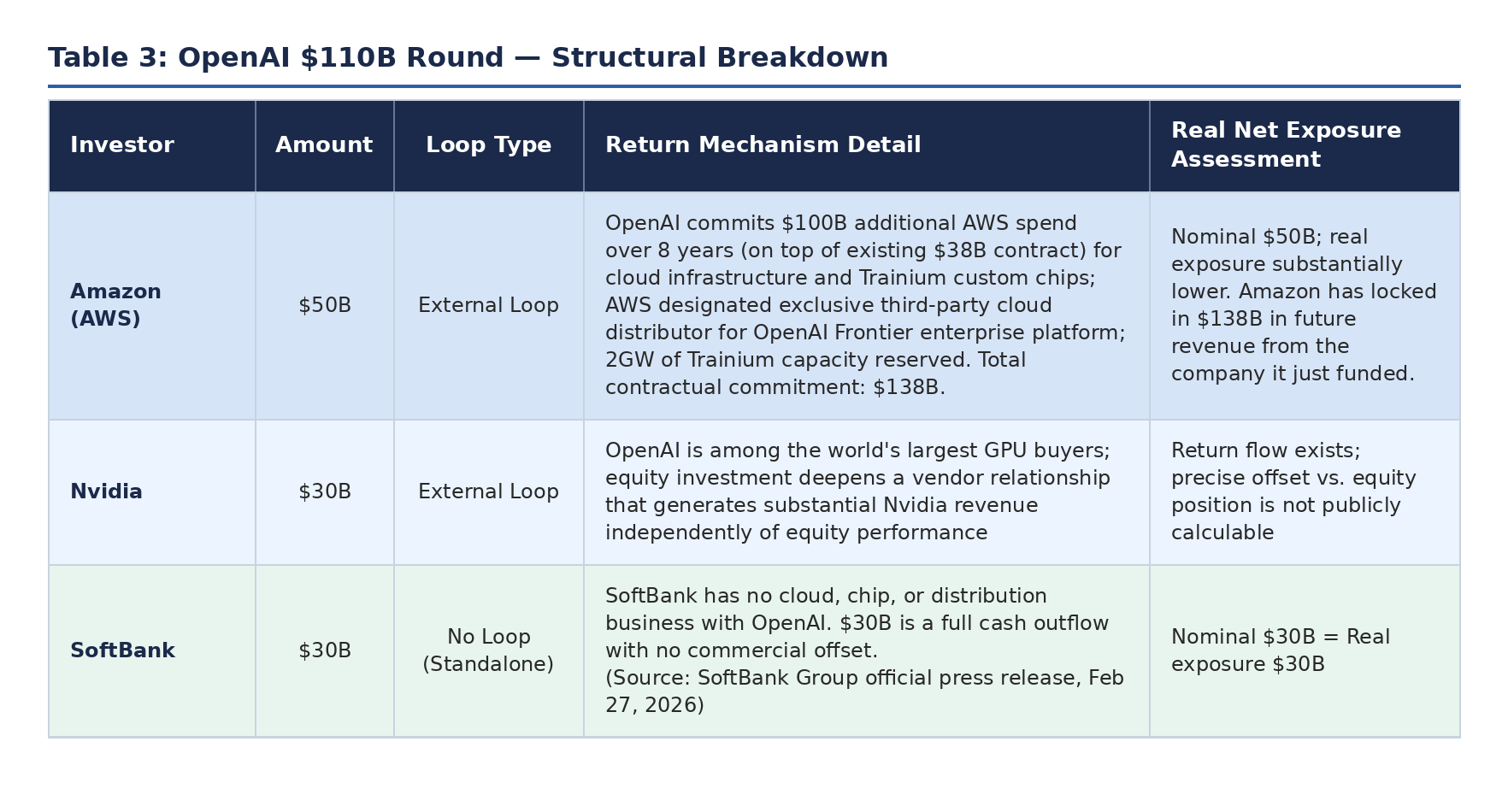
Of the three investors in OpenAI’s latest round, two arrive with substantial commercial return mechanisms already in place. Amazon’s position is the most striking. Alongside its $50 billion equity commitment, OpenAI simultaneously agreed to spend an additional $100 billion with AWS over eight years — on top of an existing $38 billion contract — and designated AWS as the exclusive third-party cloud distributor for OpenAI Frontier, its enterprise agent platform. OpenAI will also consume two gigawatts of Amazon’s Trainium compute capacity. The total contractual commitment from OpenAI to Amazon comes to $138 billion. Amazon is nominally investing $50 billion; it has simultaneously locked in over twice that amount in future revenue from the very company it just funded.
Nvidia’s $30 billion stake operates similarly in principle: OpenAI is among the world’s largest GPU buyers, and the investment deepens a vendor relationship that generates substantial revenue for Nvidia regardless of how OpenAI equity eventually performs. The precise offset is harder to quantify than Amazon’s, but the structural dynamic is the same. Between the two, roughly $80 billion — about 73% of the round — carries some degree of commercial return flow. SoftBank’s $30 billion has none.
Microsoft: The External Loop in Its Most Mature Form
Microsoft’s cumulative investment in OpenAI stands at roughly $13.8 billion, acquired over several years beginning in 2019, for a stake of approximately 27%. The relationship that surrounds that stake is what makes it unusual. OpenAI routes substantial compute spend through Azure, pays a revenue share estimated at around 20% of sales, and has committed to a further $2.5 trillion in Azure infrastructure spending. At OpenAI’s pre-money valuation of $730 billion, Microsoft’s stake carries a paper value of roughly $197 billion — more than fourteen times its nominal cost.
On Microsoft’s Net Cost
The Azure compute fees and revenue sharing arrangements generate ongoing commercial return flows that substantially reduce Microsoft’s true net exposure — well below the $13.8 billion nominal figure. Whether those flows have already made the net cost of the equity position negative is difficult to calculate precisely: compute fees flow to Azure as ordinary business revenue, not as a direct offset against the equity position, and the revenue share figure has not been publicly disclosed. The accurate characterization is that Microsoft’s effective cost of holding its OpenAI stake is very low, and may well be negative — but this is a qualitative inference, not an audited accounting conclusion.
Stargate: The Gap Between Nominal Control and Actual Capacity
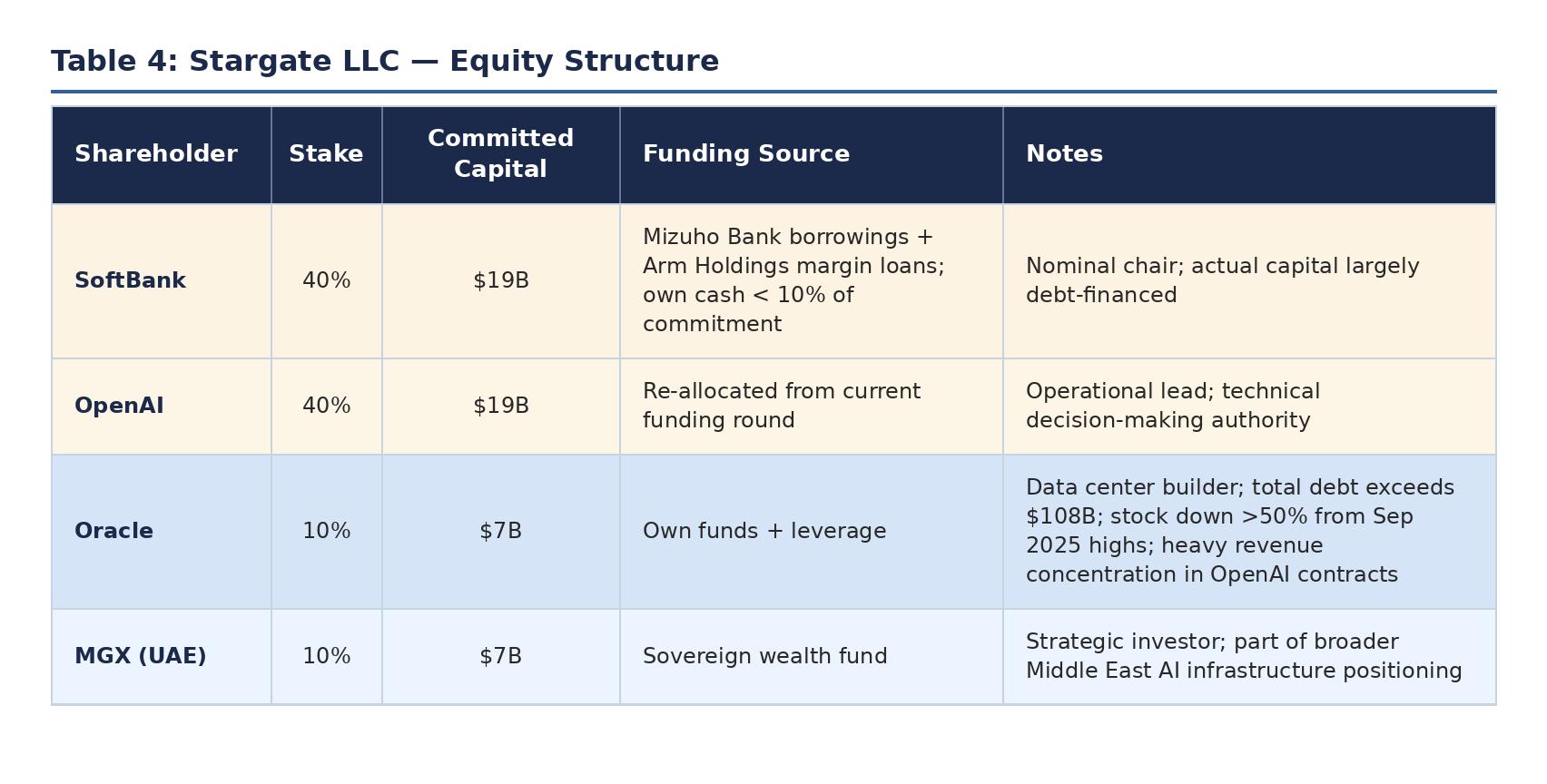
Stargate LLC, the joint venture formed in January 2025 to build $500 billion in AI infrastructure over four years, carries its own set of structural tensions. SoftBank holds 40% but funded its initial $10 billion contribution primarily through borrowings from Mizuho Bank and loans secured against its Arm Holdings stake — its own cash represented a small fraction of the nominal amount. Oracle, which holds 10%, carries total debt exceeding $108 billion and has seen its stock fall more than 50% from its September 2025 highs, with heavy revenue concentration in its OpenAI contracts. Separately, OpenAI has concluded independent bilateral deals with Azure ($2.5 trillion), AWS ($38 billion base plus $100 billion incremental), and Oracle ($300 billion) — arrangements that collectively dwarf the Stargate structure and effectively reduce its strategic centrality.
Thrive Capital: A Uniquely Positioned Outsider
Among OpenAI’s external investors, Thrive Capital occupies a position that has no real parallel in the cap table. What makes it distinctive is not any single feature but the accumulation of structural advantages layered over time: entry at a roughly $29 billion valuation in 2022 when Thrive was the only institutional term sheet on the table; subsequent secondary purchases at a fraction of current valuation; a sweetener in the 2024 convertible note round — including preferential conversion terms and additional top-up rights — not available to other investors; a call option secured at the October 2024 round giving Thrive the right to invest up to an additional $4 billion at that round’s $157 billion valuation through 2026; and a December 2025 secondary purchase of approximately $1 billion in employee shares at a roughly $285 billion implied valuation.
The dimension that moves Thrive beyond pure financial investor is the cross-holding: OpenAI has taken a stake in Thrive Holdings, an operating platform that acquires traditional accounting, IT, and professional services firms and rebuilds them on top of OpenAI products. Thrive is not just betting on OpenAI’s success — it is operationally tied to it in a way that creates aligned incentives on both sides of the relationship.
For a full account of how Thrive built this position: Buying OpenAI at a 70% Discount: How Thrive Capital Locked in $285B While Others Chase $800B
IV xAI: An Internal Loop That Just Got Much More Certain
The Funding Structure
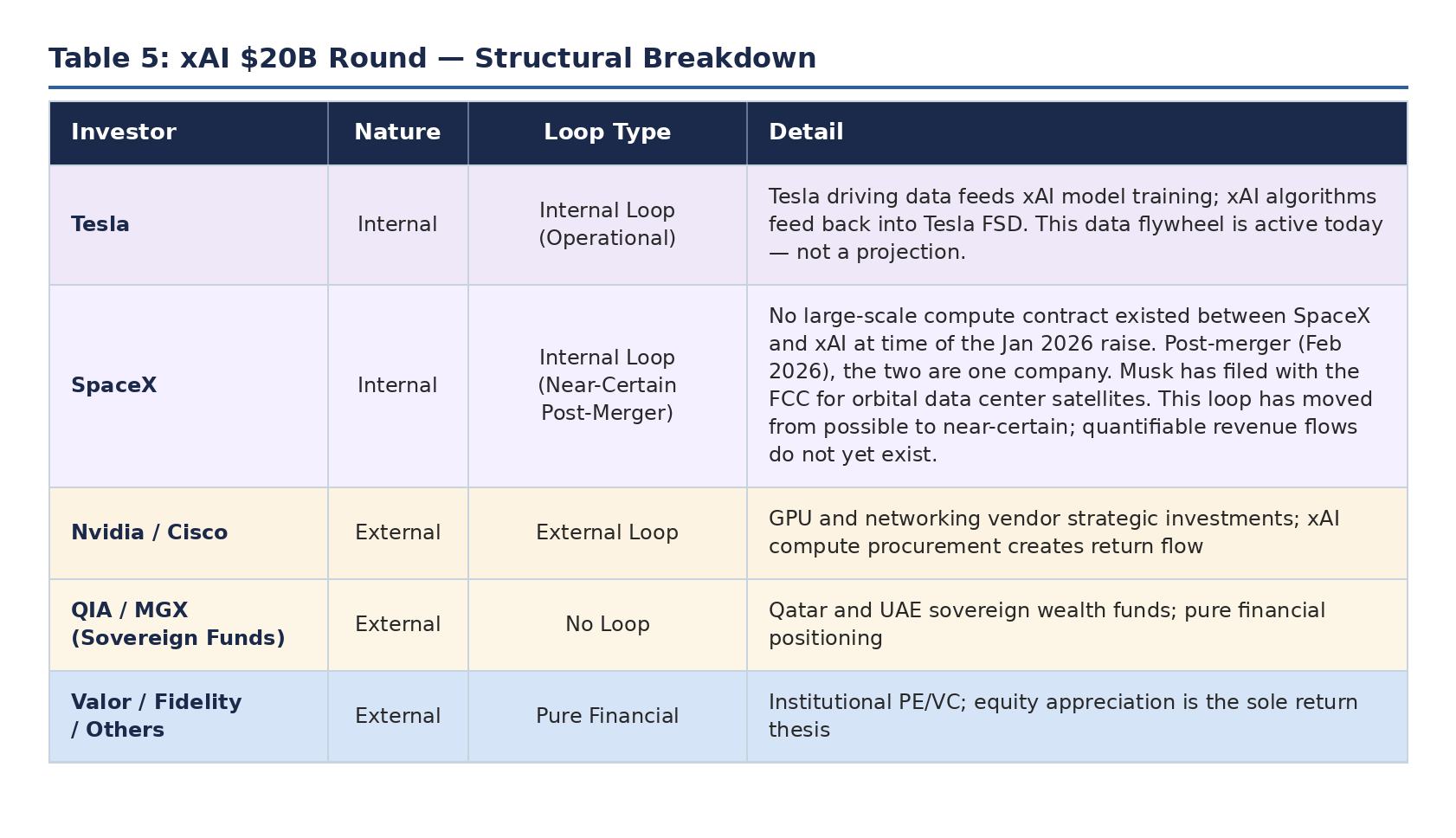
xAI’s internal loop operates on two distinct tracks, and the distinction between them matters. The Tesla data flywheel — Tesla’s driving data feeding into xAI model training, with xAI algorithms fed back into Tesla’s FSD system — is operational today. This is a functioning, bilateral exchange, not a projection.
The SpaceX orbital data center story is more recent — but it is no longer speculative in the way it once was. At the time of the $20 billion Series E in January 2026, there was no large-scale compute contract between SpaceX and xAI. By February 2026, that distinction had dissolved: SpaceX acquired xAI in an all-stock transaction that values the combined entity at $1.25 trillion ($1 trillion for SpaceX, $250 billion for xAI — a merger that also absorbed X, the social platform). Elon Musk has since filed with the FCC for permission to launch orbital data center satellites. These are not renderings in a presentation deck. They are regulatory filings. The loop between SpaceX’s launch and orbital infrastructure and xAI’s compute requirements has moved from possible to near-certain — the two organizations are now one, and the engineering rationale has cleared the first formal regulatory hurdle. Quantifiable revenue flows from this arrangement do not yet exist; the certainty that they eventually will has increased substantially.
The SpaceX Merger: Two Readings
The transaction invites two credible interpretations, and honest analysis requires acknowledging both.
The case for strategic coherence rests on energy physics: solar irradiance in orbit is continuous and unobstructed, eliminating the day-night and weather constraints that make terrestrial power grids an increasingly binding limitation on compute scaling. SpaceX’s manufacturing and launch cost curves have compressed dramatically over the past decade and show no sign of flattening. The FCC’s five-year deorbit requirement for satellites creates a structural reorder cycle that sustains launch demand indefinitely. Musk’s argument is that the constraint on AI is ultimately energy, and that SpaceX is the only organization positioned to solve it at scale.
The case for financial motivation is equally coherent. xAI was burning roughly $1 billion per month and recorded losses of approximately $1.46 billion in Q3 2025. Absorbing it into SpaceX — a profitable enterprise generating an estimated $8 billion in net income in 2025 — provides a capital buffer that xAI did not have independently. Critics also note that the vacuum environment makes convective cooling impossible, that cosmic radiation causes GPU failure rates of approximately 9% with no prospect of repair, and that Deutsche Bank’s modeling suggests orbital compute will not approach cost parity with ground-based alternatives until the mid-2030s. Some observers read the deal less as an engineering thesis and more as a mechanism to bring xAI to market on the back of SpaceX’s highly anticipated IPO, currently targeted for July 2026 at a rumored valuation of $1.5 trillion.
The correct answer likely depends on how aggressively SpaceX’s per-kilogram launch costs continue to fall — and whether thermal management problems that currently appear severe can be solved at commercial scale. Neither question has a definitive answer today.
The Commercial Reality
Whatever the orbital data center narrative ultimately delivers, the near-term business picture is straightforward: xAI’s annualized revenue run rate is approximately $1 billion against a post-money valuation of $230 billion. The 230x revenue multiple is not a valuation of today’s business. It is a valuation of a bet — on Musk’s ability to integrate Tesla’s data, SpaceX’s infrastructure, X’s distribution, and xAI’s models into something that does not currently have a comparable precedent.
V Anthropic: The Cleanest Balance Sheet in the Group
Funding Structure
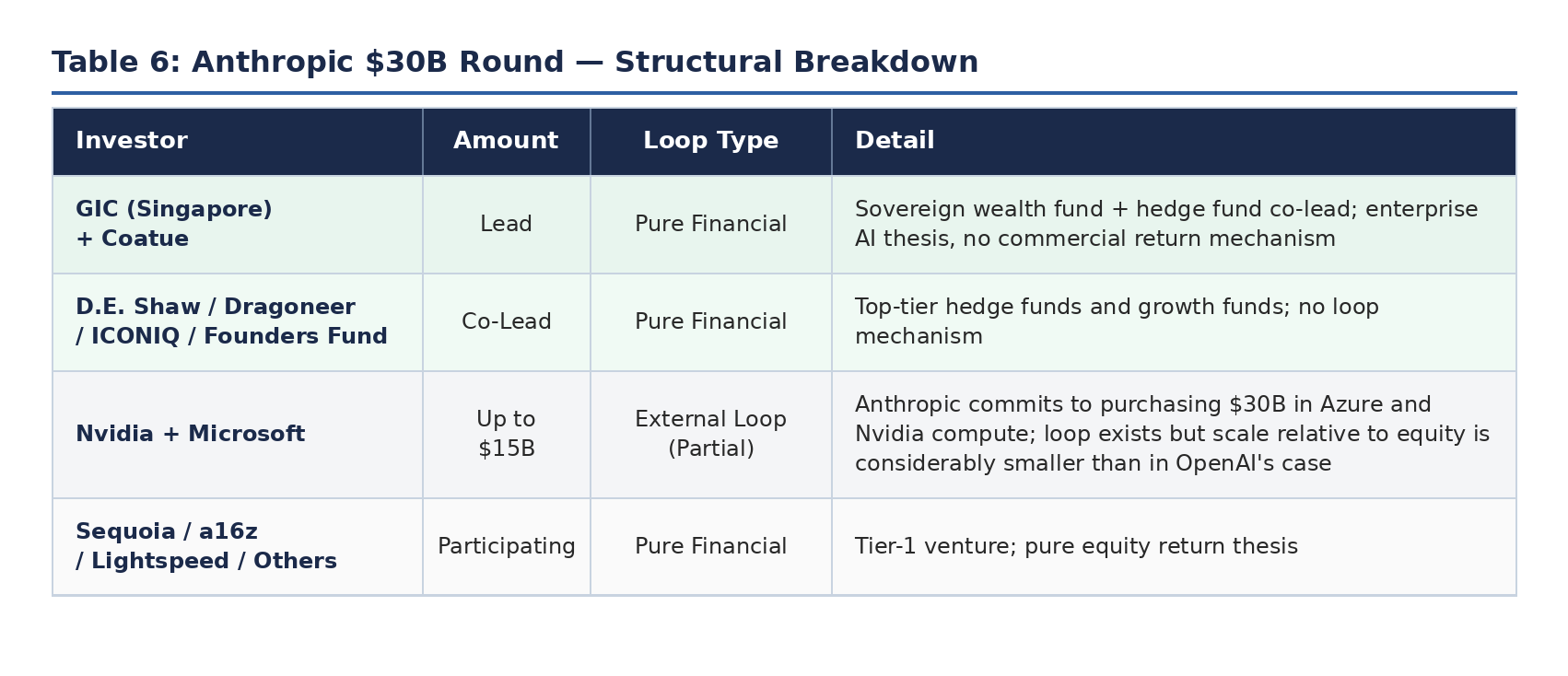
Anthropic’s Series G stands apart from the other two rounds in one meaningful respect: the majority of the capital comes from investors with no commercial return mechanism. GIC, Coatue, D.E. Shaw, Dragoneer, ICONIQ, and Founders Fund collectively anchored the round as pure financial investors. Microsoft and Nvidia participate with a partial external loop — Anthropic has committed to purchasing $30 billion in Azure and Nvidia compute — but the scale of that loop relative to their equity contribution is considerably smaller than in OpenAI’s case. The gap between nominal capital and real exposure in this round is narrower than in either of the other two.
Amazon and Google: Structural Duopoly With a Competitive Twist
Anthropic’s two largest institutional shareholders — Amazon, with $8 billion invested cumulatively, and Google, with approximately $3 billion — both arrived well before the Series G and both carry external loops of their own. Amazon’s is deeper: AWS is Anthropic’s primary cloud provider and hosts Project Rainier, the dedicated supercomputing cluster that underpins Claude’s training workloads, with ongoing compute fees reducing Amazon’s true net exposure well below its nominal $8 billion. Google’s stake comes alongside a multi-billion dollar contract for up to one million TPUs, creating a return flow that partially offsets its equity exposure, though the two are not precisely matched in scale.
The structural oddity here is that Anthropic’s two largest investors are also its two largest infrastructure vendors — and fierce competitors with each other. Anthropic benefits from the bidding tension between AWS and Google Cloud. It also carries a three-way dependency on competing suppliers that limits its strategic flexibility in ways that are difficult to fully price.
The Commercial Trajectory
Of the three companies, Anthropic’s fundamentals are currently the most closely watched by investors skeptical of AI valuations. Its annualized revenue run rate reached approximately $19 billion in early March 2026 — up from $9 billion at year-end 2025 and $14 billion just weeks earlier, according to Bloomberg. More than 300,000 enterprises use Claude; eight of the Fortune 10 are customers; enterprise accounts generate roughly 80% of revenue. Claude Code, the agentic coding tool launched publicly in May 2025, has already reached $2.5 billion in annualized revenue. At 20x revenue, Anthropic’s $380 billion post-money valuation is aggressive by traditional standards but defensible in the context of its current growth rate — which Epoch AI calculates at roughly 10x annually since first reaching $1 billion in revenue.
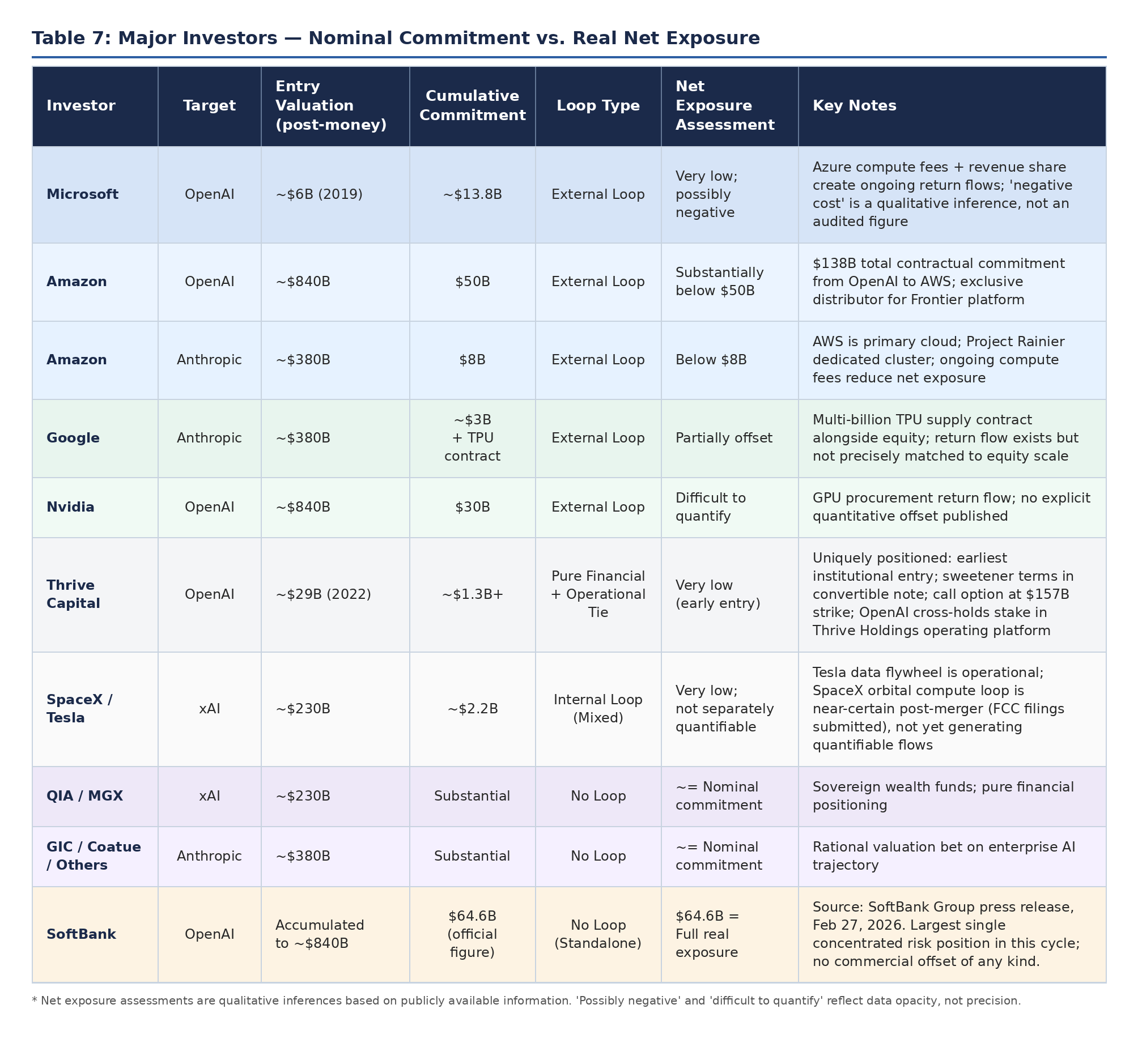
VIThe Full Picture: Who Is Really Exposed?
VII A Few Observations
On the SoftBank $64.6 Billion Figure
The cumulative SoftBank investment figure cited throughout this piece — $64.6 billion — comes directly from SoftBank Group’s official press release dated February 27, 2026, titled Follow-on Investments in OpenAI. The release states: “SBG’s cumulative investment in OpenAI is expected to total USD 64.6 billion, representing an ownership interest of approximately 13%.” The total comprises two components: approximately $34.6 billion deployed through SoftBank Vision Fund 2 since September 2024, and the $30 billion follow-on investment announced on February 27, 2026. This figure covers direct equity in OpenAI and does not include SoftBank’s $19 billion equity contribution to the Stargate joint venture.
On the Amazon-OpenAI Deal Structure
The Amazon-OpenAI relationship is worth examining as a case study in how the nominal investor / real creditor distinction plays out at scale. Amazon commits $50 billion in equity. OpenAI simultaneously commits $138 billion in future AWS spending ($38 billion existing plus $100 billion incremental). AWS becomes the exclusive third-party distributor for OpenAI’s enterprise platform. Two gigawatts of Trainium capacity are reserved. The transaction that looks, from the outside, like a straightforward equity investment is simultaneously a long-term infrastructure lock-in on terms that substantially favor Amazon’s cloud business regardless of how its equity stake ultimately performs.
On the Limits of the Framework
The nominal versus real exposure framework clarifies structure but does not resolve risk. Two points are worth holding in mind. First, the degree of return flow varies significantly within the “external loop” category — Microsoft’s arrangement is more durable and more deeply embedded than Google’s, which is more durable than Nvidia’s. Grouping them together for structural clarity should not imply that their effective offsets are comparable in scale. Second, an external loop reduces the initial cost of an equity position; it does not eliminate exposure to the underlying business. If OpenAI’s commercial scale contracts, Azure compute fees contract with it. The loop is a cost structure advantage, not a hedge against fundamental performance.
On SoftBank’s Position
SoftBank’s real net exposure to OpenAI is approximately $64.6 billion — the full nominal amount, with no commercial offset whatsoever. It is the only major investor in this cycle writing checks with nothing coming back through a side door. Whether that is prescient or reckless depends entirely on whether OpenAI’s long-term commercial value can justify a post-money valuation of approximately $840 billion. Masayoshi Son has framed the bet in terms of AGI — a call option on a transformation in the structure of the global economy. That framing is either correct or it is not. There is no middle path at $64.6 billion with no hedge.