


Drugs used to be a fixed product. In the future, they may become a system that continuously reads a patient, computes on that patient, and manufactures the medicine for that patient alone.
On Wednesday, August 19, 2026 (U.S. Eastern Time), Merck and Moderna announced a striking Phase 3 clinical result: in a trial enrolling 1,137 patients with surgically resected melanoma, Intismeran autogene combined with Keytruda significantly improved recurrence-free survival and distant metastasis-free survival compared with Keytruda alone. In plain language, for high-risk melanoma patients who had already had surgery, the two outcomes people fear most — “recurrence” and “metastasis” — were both meaningfully delayed. These correspond to the trial’s primary endpoint (RFS, recurrence-free survival) and its key secondary endpoint (DMFS, distant metastasis-free survival); whether patients ultimately live longer as a result — overall survival, or OS — will only be answered with further follow-up. The companies also said that no new safety concerns have emerged so far.
The market’s reaction was even more dramatic than the result itself. On the day the news broke, Moderna’s stock closed up 176.97%, at $174.38, after touching an intraday high of $176.66 — the largest single-day gain in the company’s history as a public company. Market capitalization jumped from roughly $25 billion to roughly $69.6 billion in a single trading day.
It’s worth clearing up a common misconception first. Many news reports have called Intismeran a “cancer vaccine,” which makes it easy to assume it’s a shot that prevents cancer. It isn’t. It’s not a preventive vaccine at all, but an individualized treatment given after surgery — designed to clear out the small number of cancer cells that may remain in the body and lower the risk of recurrence and metastasis. It’s meant for patients who are already diagnosed and have already had surgery, not for the healthy general public.
Making full sense of this event requires looking at it from six angles: first, whether it can grow from a melanoma therapy into a platform that works across cancer types; second, how much value non-generative AI can really create in the life sciences; third, whether one-patient-one-drug medicine can move from the lab into industrial-scale production; fourth, how regulators and payers can handle a drug whose composition differs for every single patient; fifth, why a company that once sat on nearly $20 billion in cash is still borrowing at close to 10% interest; and sixth, who ultimately ends up holding the platform — and the profits — in this new kind of drug-making system.
Let’s unpack each of these in turn.
1. First, it proves something: one-patient-one-drug medicine can add real benefit on top of standard immunotherapy
Intismeran’s earlier research code names were mRNA-4157 and V940. It isn’t a vaccine meant to prevent cancer in healthy people — it’s an individualized therapeutic vaccine given after a tumor has been surgically removed.
After melanoma patients have surgery, imaging may no longer show any visible tumor, but a small number of cancer cells can still remain in the body. Months or years later, those cells can regrow into a local recurrence or spread elsewhere as metastasis.
One of today’s standard treatments is Merck’s PD-1 inhibitor, Keytruda. It works by releasing a “brake” on the immune system, freeing T cells to attack cancer. But releasing the brake isn’t the same as telling the immune system who to attack. That’s exactly what Intismeran adds: a “wanted poster” tailored to the patient’s own tumor.
In the INTerpath-001 trial, 1,137 patients with fully resected stage IIB, IIC, III, or IV cutaneous melanoma were randomized 2:1. The treatment arm received Intismeran plus Keytruda; the control arm received placebo plus Keytruda. The study was global, multicenter, randomized, double-blind, and active-controlled.
At a pre-specified interim analysis, the combination significantly improved both the primary endpoint (RFS) and the key secondary endpoint (DMFS) compared with Keytruda alone.
One important clarification: the trial compared “Intismeran plus Keytruda” against “Keytruda alone” — not the individualized therapy against standard care on its own. Keytruda remained the shared foundation of treatment in both arms. Even so, this is the first time an individualized neoantigen therapy has posted a positive Phase 3 result, and the first time an mRNA cancer treatment has shown a statistically significant incremental benefit on top of standard immunotherapy in a large Phase 3 study.
Its earlier Phase 2 trial enrolled only 157 patients. After five years of follow-up, the combination cut the risk of recurrence or death by 49% and the risk of distant metastasis or death by 59%. But because the sample was small and the study was open-label, the market kept wondering whether those results would hold up in a larger trial.
Now, with the Phase 3 trial expanded to 1,137 patients and run double-blind, RFS and DMFS both succeeded again — substantially easing concerns that the Phase 2 results wouldn’t replicate at scale. That said, the Phase 3 hazard ratio (HR — the core measure of how much the treatment group’s risk of recurrence or metastasis fell relative to the control group), the absolute recurrence rate, and the exact follow-up duration haven’t been disclosed yet, and overall survival (OS) is still being followed. Those numbers are what will really determine how clinically significant this positive result is.
If the Phase 3 hazard ratio comes in close to the Phase 2 figure of 0.51, it could redefine post-surgical melanoma treatment. If it comes in closer to 0.70, the result would still be meaningful, but the pricing power and market size would look quite different. For patients with relatively low recurrence risk — stage IIB in particular — what matters isn’t the size of the relative risk reduction, but how many recurrences are actually prevented per 100 patients treated.
It’s also worth remembering that melanoma already carries a relatively high mutational burden and tends to respond well to immunotherapy. That makes it a good proving ground for a neoantigen vaccine — but it doesn’t mean the approach will work the same way across all solid tumors.
Merck and Moderna have already extended Intismeran into non-small-cell lung cancer, kidney cancer, and bladder cancer, among other areas. The next important step isn’t proving it works in melanoma again — it’s proving the approach can cross over into other cancer types.
If the lung cancer Phase 3 trial also succeeds, Intismeran will, for the first time, have genuine evidence of being a cross-cancer platform. If subsequent cancer types fail one after another, it may end up being an excellent but narrowly applicable melanoma therapy. A win in a second cancer type would meaningfully strengthen the case for a platform — but it still wouldn’t prove the approach works broadly across all solid tumors.
2. The other path — overshadowed by generative AI
What makes Intismeran unusual is that every patient receives a different drug sequence.
After a tumor is surgically removed, Moderna first sequences both the tumor tissue and a normal sample from the patient to identify mutations that exist only in the cancer cells.
A single melanoma patient may carry hundreds or even thousands of mutations, but most of them have no therapeutic value: some don’t produce a protein at all, some can’t be presented by the patient’s particular HLA system, some fail to activate T cells, and some exist in only a small fraction of the cancer cells.
Moderna describes this as a fully integrated set of AI algorithms: they take a patient’s tumor and blood NGS sequencing data as input, analyze the mutations, predict up to 34 neoantigens most likely to trigger an effective immune response, and encode them into a single mRNA sequence unique to that patient.
So the AI inside Intismeran isn’t generative AI in the ChatGPT sense. Its main job isn’t to invent a brand-new molecule out of thin air — it’s to solve a much more specific problem:
Given a patient’s hundreds of tumor mutations, which 34 should be chosen as immune targets?
This looks more like a “predictive, ranking-type AI” — there’s no need to get hung up on which exact category of machine learning it falls under. What matters is that its job is to filter and rank, not to generate.
There’s another value here that’s easy to overlook. As treatment data accumulates over time, the relationships among mutation, HLA type, neoantigen, immune response, and clinical outcome can, in principle, be fed back to train and improve the next generation of the algorithm. Moderna itself describes this kind of continuous learning as one of its platform goals — if that data flywheel starts turning, what Intismeran accumulates won’t just be treatment cases, but increasingly accurate prediction capability. That’s a key reason it could evolve from a single therapy into a platform.
AlphaFold 2 offers a similar example. Its core task isn’t to invent a protein that doesn’t exist in nature — it’s to predict the three-dimensional structure a given amino acid sequence is most likely to fold into. One predicts structure from sequence; the other selects treatment targets from tumor mutations. Both point to the same conclusion: AI’s most important value in the life sciences doesn’t come only from “generating” things.
Today’s market tends to treat AI as synonymous with large language models and content generation. But the real bottleneck life sciences has faced for a long time usually isn’t a shortage of candidates — it’s not knowing:
• which target is real;
• which mutation is worth attacking;
• which molecule will turn out to be toxic;
• which patients will actually respond;
• and, out of a hundred thousand candidates, which ten are worth taking into the lab.
Life sciences isn’t short on imagination. What it’s short on is judgment.
Generative AI can dream up a hundred million new molecules, but no lab can synthesize and test all hundred million of them. The bigger the candidate space gets, the more the prediction, ranking, and elimination models matter.
Intismeran is an instructive case in point: AI doesn’t necessarily have to create a drug from scratch. As long as it can make sufficiently accurate choices in a space too complex for humans to sort through by hand, it can directly determine what the drug is made of.
This isn’t simply “AI-assisted drug-making.” It’s closer to a new category: an “algorithm-defined drug.”
3. From mass production to mass personalization
The logic of traditional pharmaceutical manufacturing is to develop one fixed molecule, then produce as much of that same drug as possible, at scale.
Intismeran works completely differently. Every new patient means starting the whole process over again:
Tumor sampling → gene sequencing → mutation identification → algorithmic selection → mRNA design → individual manufacturing → quality testing → shipment back to the patient.
Every patient goes through the same technology platform and manufacturing process, but each person ends up with a different mRNA sequence.
This is a kind of “mass personalization.” The hard part isn’t just the R&D — it’s speed, cost, and organizational capability.
Once a patient has had their tumor removed, the treatment window doesn’t wait indefinitely. Hospitals need to obtain a usable sample in time, the sequencing system needs to correctly identify the mutations, the algorithm needs to finish selecting neoantigens, the factory needs to manufacture an mRNA batch that belongs to exactly one person, and the finished drug then needs to make its way back to the right patient.
For a traditional drugmaker, one production batch might serve tens of thousands of people. For Intismeran, one batch, in principle, serves exactly one person.
To be precise, what INTerpath-001 demonstrates is that this individualized design-and-manufacturing system can already be embedded inside a global Phase 3 trial covering 1,137 patients, handling hundreds of patient-specific batches at once — since patients were randomized 2:1, it’s the treatment arm, not all 1,137 patients, that actually went through individualized production. But a clinical trial’s scale still isn’t the same thing as commercial scale. If the therapy moves into larger cancers such as lung cancer, the number of eligible patients could rise from the thousands into the tens of thousands or more.
At that point, what sets the ceiling on the business won’t just be efficacy. It will also come down to:
• how long it takes from tumor sampling to drug delivery;
• how many patients can successfully make it through design and manufacturing;
• what it costs to manufacture a single patient’s dose;
• how many people a single factory can serve each year;
• whether hospitals in different countries can plug into one unified process;
• and whether quality can stay consistent while the whole operation scales up.
Moderna is already building a manufacturing facility dedicated to Intismeran in Marlborough, Massachusetts, using automation and robotics to boost individualized production capacity. The real moat here is likely not just mRNA patents, but the combined capability formed by algorithms, factories, quality systems, and clinical networks working together.
4. What regulators will be approving is no longer just a fixed molecule
One point worth clarifying first, since it’s easy to overstate: this isn’t the first time regulators have dealt with “one patient, one batch.” CAR-T and other autologous cell and gene therapies already accustomed the FDA to patient-specific lots — manufacturing cycles measured in weeks to months, and the need to precisely match a patient’s own sample to their final drug product. Regulatory guidance already covers this territory.
What’s genuinely new about Intismeran is that, within a single approved product, an algorithm follows a fixed set of rules to decide a different drug sequence for each patient — rather than a human choosing from a limited set of preset formulations. In other words, regulators have already gotten past the “patient-specific manufacturing” step. What comes next is “algorithm-defined composition.” In typical AI-driven drug discovery, AI can explore, generate, and eliminate large numbers of molecules randomly in the early stages; but once a candidate molecule is locked in, the company then builds manufacturing, animal studies, and clinical trials around that one fixed molecule.
Intismeran is different. Even after approval, the algorithm still has to run fresh for every new patient. Regulators aren’t looking at one mRNA sequence that never changes — they’re looking at a drug platform capable of continuously designing new sequences.
Regulators don’t need to retrace every algorithmic trial-and-error step from early research, but they do need to determine:
• which patients are eligible to enter this process;
• what standard a tumor sample has to meet;
• what rules govern how neoantigens get selected;
• how changes to the algorithm or selection criteria get validated;
• how every batch of differently-sequenced mRNA meets the same quality and safety standard;
• and how the patient sample, the design output, and the final drug stay correctly matched to one another.
In other words, traditional drug regulation mainly deals with a fixed product. Intismeran requires regulators to understand both the product and the manufacturing platform at the same time.
Payment systems face a new question too. Is an insurer paying for a drug — or for an entire bundle of services that includes sequencing, algorithmic design, individualized manufacturing, and treatment? And if a drug has already been manufactured for a patient but that patient’s condition changes and they can no longer use it, who bears that cost?
In the end, pricing still comes back to absolute efficacy. If the combination therapy is very expensive but only prevents a handful of recurrences in low-risk patients, payers will be cautious. If it substantially cuts distant metastasis and death in high-risk patients, willingness to pay will look completely different.
That’s why the absolute recurrence rates and staging results in the full Phase 3 dataset may matter more, in the end, than the “world’s first mRNA cancer therapy” headline.
5. Nine months bought with expensive debt
2022 was Moderna’s peak: full-year revenue of $19.263 billion, net income of $8.4 billion, and $18.2 billion in cash and investments on the balance sheet at year-end. Three years later, the picture reversed — COVID vaccine demand shrank, 2025 revenue fell to $1.9 billion, and the company posted losses in each of 2023, 2024, and 2025, totaling more than $11 billion.
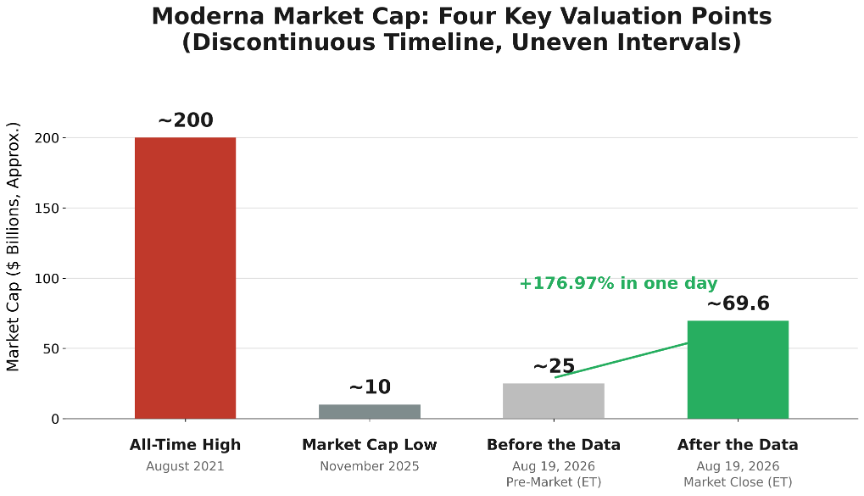
Chart: Moderna’s market cap at four key points (approximate values, based on public reporting and company disclosures; the x-axis shows discrete points rather than an evenly spaced timeline — the four intervals span roughly 4 years, 9 months, and 1 day, respectively).
In November 2025, near a low point when Moderna’s market cap briefly dipped below $10 billion, the company took out a senior secured term loan of up to $1.5 billion from a credit fund managed by Ares Management, secured by a first-priority lien on most of the company’s assets, with an initial maturity date of November 24, 2030. The interest rate was SOFR (a floating short-term benchmark rate) plus 5.5 percentage points — an effective rate of roughly 9.38% at the end of 2025, falling to roughly 9.17% by the end of March 2026. The first $600 million was funded immediately, with the remainder released in tranches tied to draw timing and regulatory milestones.
Economically, this loan functions much like “trading a higher cost of debt for time and non-dilutive capital to get across a critical clinical data readout” — had Moderna instead raised $1.5 billion by issuing new shares at the time, the dilution could have run close to 16%. But one clarification is worth making: legally, this isn’t a short-term bridge loan. It’s a long-term, asset-backed financing that doesn’t mature until 2030. Whether it was designed specifically to “get the company to the 2026 Phase 3 readout” is this article’s own inference, not something the companies have stated.
Only nine months have passed since the loan was signed, and Moderna’s market cap has already climbed from roughly $25 billion to roughly $69.6 billion. But to be clear: a rising share price doesn’t add a single dollar of cash to the balance sheet on its own, and the underlying cash-burn problem hasn’t gone away because of it. What has genuinely changed is the company’s financing flexibility — its options for future equity raises, convertible debt, or refinancing have improved markedly, and lenders’ margin of safety has widened along with it.
6. Who captures the value of this system
Intismeran isn’t a product Moderna developed on its own.
Merck and Moderna first partnered in 2016. In 2022, Merck paid $250 million to exercise its option to co-develop and commercialize the program. Since then, the two companies have shared costs globally and split Intismeran’s profits and losses evenly.
The two companies bring different capabilities to the table.
Moderna holds the mRNA technology, the neoantigen algorithm, and the individualized design-and-manufacturing platform; Merck brings Keytruda, a global oncology clinical infrastructure, regulatory expertise, hospital networks, and commercial reach.
For Merck, the payoff isn’t just half of Intismeran’s profits. Because the combination therapy is built on top of Keytruda, Intismeran’s success helps reinforce Keytruda’s central position in cancer treatment and gives Merck a new combination pathway to lean on as it faces revenue pressure from Keytruda’s eventual patent expiration.
If this model extends into lung, kidney, and bladder cancer, future competition may no longer just be about “who owns the best molecule.” It could instead come down to:
• who holds more high-quality tumor and immune-response data;
• whose neoantigen prediction model is more accurate;
• who can complete individualized manufacturing fastest;
• who can connect hospitals, sequencing, algorithms, and factories into a single pipeline;
• who has an immunotherapy worth combining it with;
• and who can keep feeding treatment outcomes back into the next generation of the model.
The moat in this system isn’t a single isolated AI model, or a single mRNA factory. It’s the closed loop formed by data, algorithms, manufacturing, clinical operations, and payment networks working together.
Conclusion
Intismeran’s positive Phase 3 result is, first and foremost, a breakthrough in melanoma treatment. But its significance doesn’t stop at melanoma.
It shows that predictive AI can directly determine the content of an individualized drug. It shows that one-patient-one-drug medicine can make it into a large-scale global clinical trial. And it shows that capital can buy a biotech company the time it needs to get through a long stretch before its technology pays off.
But it hasn’t proven everything yet. It still needs a larger indication like lung cancer to prove the breadth of the platform, commercial-scale manufacturing to prove that one-patient-one-drug medicine can actually scale, the full Phase 3 dataset to prove its absolute clinical value, and, eventually, the payment system to answer how many patients this kind of therapy can actually reach.
What Intismeran may really be changing isn’t that humanity now has one more drug. It’s that the very definition of a drug is starting to shift.
In the past, the basic unit of the pharmaceutical industry was a fixed, pre-defined, repeatably manufactured product. In the future, it may instead be a system that continuously reads a patient, computes on that patient, and remanufactures the drug anew for each one.