


— Silicon Valley is witnessing a historic power struggle, but dethroning the king of compute will be a bloody war of attrition.
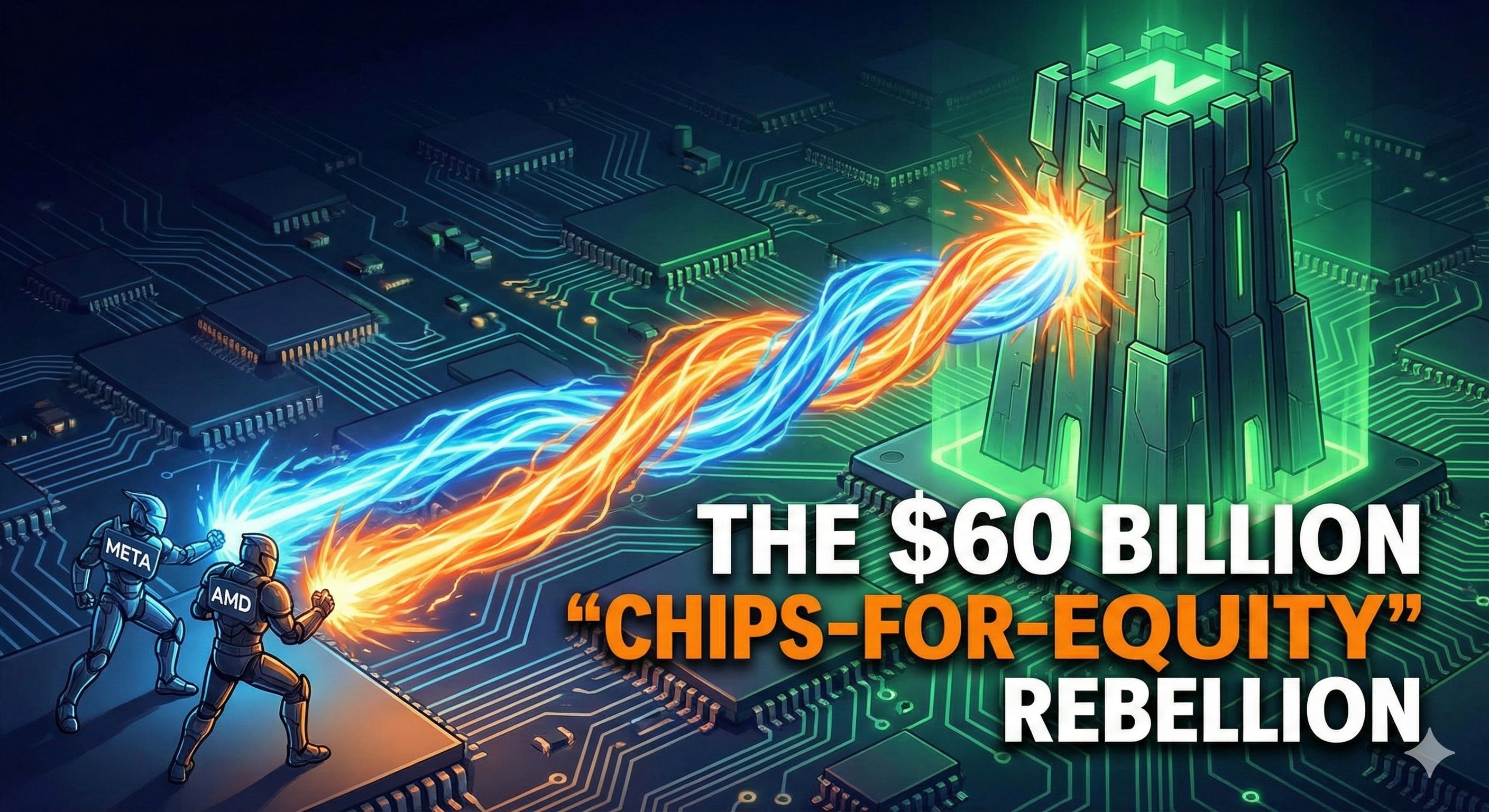
For the past three years, the underlying logic sustaining Silicon Valley’s AI boom has been simple and expensive: Big Tech pays the Nvidia tax. However, with Meta and AMD recently striking a massive $60 billion “chips-for-equity” agreement, the first major structural rebellion has officially begun.
This is not merely a massive procurement order; it is a calculated attempt by a mega-customer to force a paradigm shift toward “compute self-sufficiency” and “deep supplier alliances.” Yet, while the scale of this deal is unprecedented, treating it as the immediate dawn of a new “duopoly” dangerously underestimates the depth of Nvidia’s moats and the brutal reality of the semiconductor battlefield.
Here is the anatomy of Meta’s $60 billion gamble—and the massive structural hurdles it still faces.
1. The Financial Hedge: Escaping the Margin Trap
To understand Meta’s motive, one must look at the agonizing reality of its supply chain. Over the past few years, building the sprawling Llama model family and running daily recommendation algorithms for Instagram and Facebook required tens of billions of dollars in Nvidia H100 and Blackwell GPUs.
However, Nvidia’s staggering 75% gross margin and volatile lead times mean Meta’s AI empire is essentially built on leased land. With Meta’s capital expenditures (Capex) projected to reach an astonishing $135 billion by 2026, a pure buyer-seller relationship is financially unsustainable.
Through this new agreement, Meta commits to large-scale purchases of AMD’s MI450 series accelerators over five years. Crucially, in exchange, Meta secured warrants locking in up to a 10% equity stake in AMD. This “customer-turned-shareholder” model creates a financial hedge: if AMD’s valuation surges on the back of Meta’s massive orders, Meta’s hardware expenditures are offset by equity appreciation. It is a brilliant financial maneuver to subsidize infrastructure costs, but financial engineering alone cannot win a tech war.
2. The Software Illusion: PyTorch vs. The Iceberg of CUDA
The bullish thesis for AMD relies heavily on Meta’s software supremacy. Meta controls PyTorch, the world’s most popular deep learning framework. Over the past year, Meta’s engineers have aggressively optimized AMD’s open-source software stack, ROCm (Radeon Open Compute), hoping to make the underlying hardware commoditized and interchangeable.
However, assuming PyTorch can instantly dissolve Nvidia’s software moat is a severe underestimation of the “iceberg effect” of CUDA. CUDA’s lock-in is not merely a high-level software API issue; it is an entrenched, end-to-end ecosystem. Beneath the surface lies:
TensorRT for highly optimized inference compilation.
cuDNN providing heavily tuned primitive libraries.
The proprietary NVLink ecosystem dictating multi-GPU scaling.
A decade of bulletproof enterprise toolchains, driver stability, and a deeply ingrained developer training system.
ROCm’s “maturity gap” is not something that can be closed in a year or two, even with Meta’s world-class engineering team forcing compatibility in its own hyperscale data centers. Prying the broader, long-tail developer ecosystem away from CUDA remains a monumental task.
3. The Inference Threat: AMD’s Window Might Be Narrower Than It Appears
AMD’s strategic wedge is the explosively growing inference market, where the cost-to-performance ratio of the MI450 looks highly attractive. However, assuming the inference market naturally favors AMD ignores the true endgame of AI compute.
The real existential threat to Nvidia in inference isn’t necessarily AMD’s merchant silicon—it is Custom ASICs and ARM-based chips.
Google is already deploying its highly efficient TPUs.
AWS relies heavily on Inferentia and Trainium.
Meta itself is aggressively developing the MTIA (Meta Training and Inference Accelerator).
As inference tasks become more specialized and the industry obsesses over power consumption and thermal limits, dedicated ASICs will inevitably eat into the market share of general-purpose GPUs. AMD is fighting fiercely to capture a window in the merchant silicon space, but that window may be smaller—and closing faster—than optimists believe.
4. The Empire Strikes Back: Nvidia’s Lethal Counter-Offensive
Finally, the narrative of a smooth transition from a “unipolar” to a “bipolar” market assumes Nvidia is a passive incumbent. It is not. Jensen Huang possesses a terrifying arsenal to crush rebellions.
Nvidia is heavily armed to wage a brutal, bloody war of attrition:
Margin Compression: With extremely high gross margins, Nvidia has unparalleled room to slash prices, initiating a price war that AMD cannot comfortably match without destroying its own balance sheet.
Software/Hardware Bundling: Nvidia can leverage its upcoming Rubin architecture to bundle software services, making defection economically painful.
Supply Chain Weaponization: Nvidia can offer priority supply agreements and favorable allocations to loyal customers, creating a “prisoner’s dilemma” that fractures any coalition of challengers.
Conclusion: A Challenger, Not a Co-Ruler (Yet)
Mark Zuckerberg’s $60 billion alliance with AMD is the boldest move yet to secure pricing power over the “digital oil” powering the AGI race. It proves that Big Tech is no longer willing to write blank checks to Santa Clara.
However, Meta and AMD are currently just that—a highly capitalized, incredibly dangerous challenger alliance. They have fired a massive shot across the bow, but they have not established a duopoly. Breaking the CUDA ecosystem, surviving the pivot to custom ASICs, and withstanding Nvidia’s inevitable price and supply counter-attacks will require years of flawless execution. The Silicon Valley compute war hasn’t ended; the bloody part has just begun.