


How LLMs Just Made Pseudonymity a $1 Fantasy
Imagine this: You’ve spent years posting on Hacker News, Reddit, or some obscure forum under a clever throwaway handle. No real name, no photos, just your thoughts, quirks, and the occasional “this one weird project I worked on in college.”
You thought you were safe. Invisible. A digital ghost.
Turns out, the ghosts just got doxxed by AI—and it cost less than your morning latte.
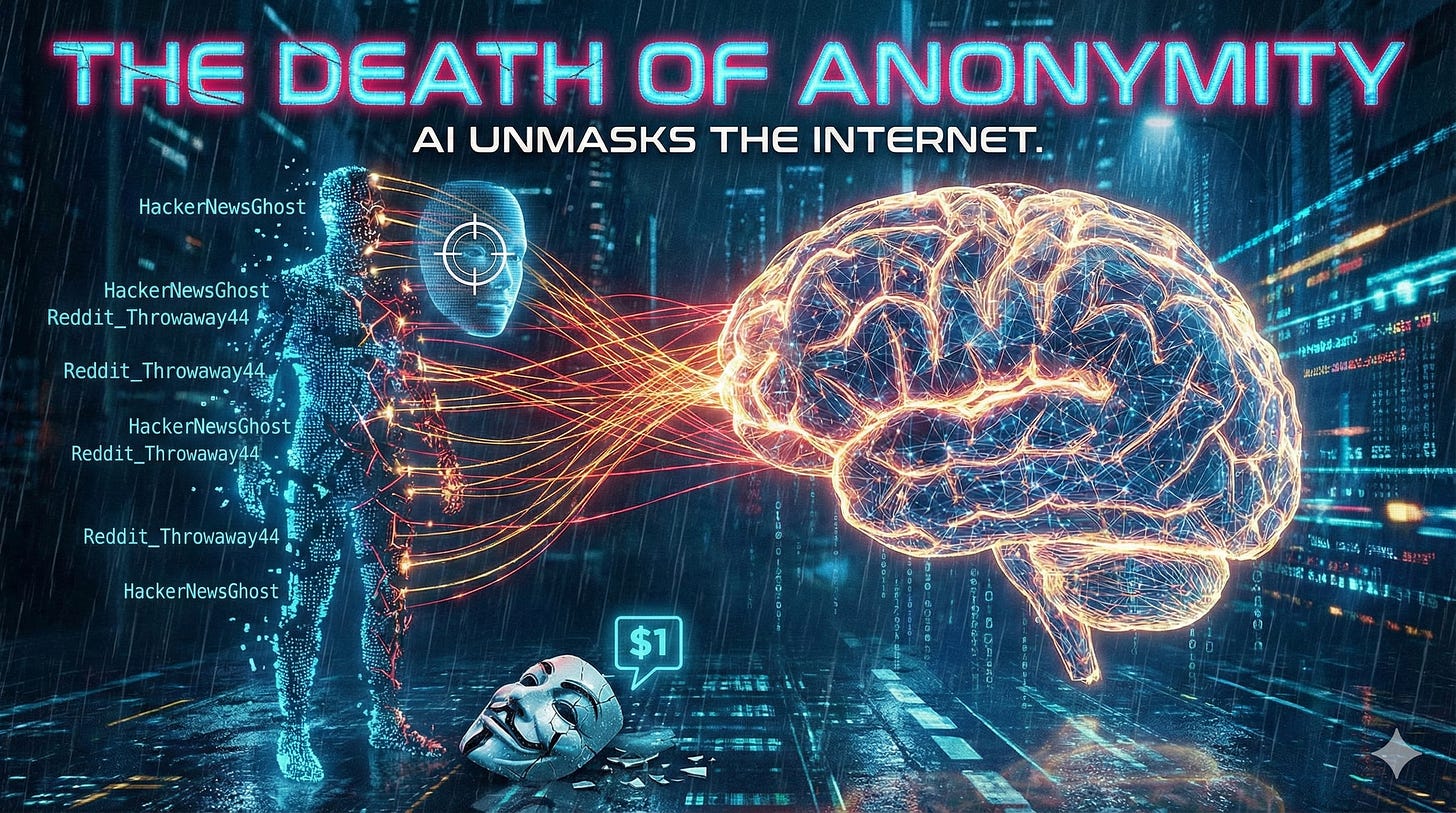
In February 2026, researchers from ETH Zurich and Anthropic dropped a bombshell paper titled “Large-scale online deanonymization with LLMs.” Led by a team of elite researchers (Simon Lermen, Daniel Paleka, and others), the work isn’t some dystopian fever dream. It’s a meticulously engineered, fully automated system that turns your scattered online ramblings into a high-confidence ID match.
And the results are nothing short of terrifying.
Meet ESRC: The Four-Step AI Detective
The team built a modular pipeline they call ESRC. Think of it as Sherlock Holmes on steroids, but the detective is a chain of LLMs that never sleeps. No human investigator. No fancy databases. Just raw, unstructured text.
Extract: The AI reads your posts like a behavioral psychologist, pulling out “micro-signals”—your writing quirks, obsessions, cities you’ve vaguely mentioned, hobbies that slip through, even the rhythm of your sentences.
Search: Those clues get turned into dense vector embeddings and hurled into massive candidate pools (LinkedIn profiles, other forums, public databases). It’s semantic matchmaking on a planetary scale.
Reason: A heavy-duty model (think GPT-5.2 level) plays detective, cross-examining the shortlist for contradictions or uncanny alignments. More thinking time = dramatically better accuracy.
Calibrate: Finally, the system only raises its hand when it’s really sure, letting you tune for sky-high precision.
The Numbers That Should Keep You Up at Night
Old-school deanonymization attacks required neat, structured data. LLMs laugh at that. They feast on messy human text—the very soul of online life. The experiments were ruthless:
Hacker News users matched to LinkedIn: 68% recall at 90% precision. (Translation: The AI correctly identified two-thirds of targets, and when it committed to a guess, it was right 90% of the time. Classical methods? A pathetic 0.1%.)
Reddit academics posting under pseudonyms: 52% identified.
Redacted interview transcripts: 9 out of 33 explicitly anonymized scientists were still unmasked.
Temporal split test (simulating you a year later): Up to 67% recall at 90% precision.
Scale it up? The paper projects roughly 35% recall at 90% precision even against a million candidates.
The Cost? $1–4 per target. The total experiment budget was under $2,000.
The Sobering Reality Check
Before you panic-delete every account, here’s the nuance the viral X threads sometimes gloss over: The datasets were built from originally public, non-anonymous profiles that were later artificially scrubbed of usernames and links. These weren’t hardened privacy ninjas deliberately avoiding personal breadcrumbs. They were regular users posting openly.
True anonymity warriors—who compartmentalize, rewrite their voice, and never slip in unique details—will fare better. For now.
But the trendline is merciless. Smarter models, cheaper compute, and more reasoning steps make the attack stronger by the month. The researchers themselves are pessimistic, noting that the pipeline cleverly splits into “benign” subtasks, dodging most AI safety guardrails.
“The practical obscurity protecting pseudonymous users online no longer holds.” > — The Researchers’ Blunt Takeaway
So… What Now?
Practical anonymity—the comforting illusion that “nobody will connect the dots”—is dead for most people. The internet’s grand experiment in pseudonymous freedom just hit its expiration date.
The paper doesn’t preach doom; it forces honesty. Threat models must change. If you value separation between your online selves, you need to:
Compartmentalize ruthlessly.
Vary your voice like a method actor.
Accept that the age of casual throwaways is over.
The AI genie isn’t going back in the bottle. It’s already reading your old comments, connecting the dots, and waiting for the next query.
Welcome to the post-anonymity era. Bring your best pseudonym—or accept that, for a few bucks and a few clever prompts, the internet now knows exactly who you are.