


AI Vector Ocean
The Structural Forces Behind AI.
The Platform
Most analysis of AI starts with a question that sounds reasonable: what does AI mean for my portfolio, my business, my industry?
The problem is that this question has a prerequisite — one that most analysis skips entirely.
The first prerequisite is understanding the object itself. What is AI, actually — how does it behave, what drives that behavior, and what are its real constraints and limits? Conclusions reached without this foundation are built on assumption, not understanding.
The second prerequisite is framework. AI is not a single-dimensional phenomenon with spillover effects. It is simultaneously a technology story, a capital story, an infrastructure story, a geopolitical story, and an industry reinvention story — and the most consequential dynamics emerge not within any single layer, but from how the layers interact. A framework that captures one dimension well will systematically distort the others.
Only once those two questions are answered does the third become tractable: given what AI actually is, and given how these forces are moving, what should you do — how should you position, deploy, and allocate?
AI Vector Ocean is a research, consulting, and capital advisory platform built around that sequence. Our work begins with research: rigorous, framework-driven analysis of what AI actually is and how its structural forces are moving. That research informs consulting engagements — helping institutions and corporates develop a grounded view of where AI creates and destroys value, and reposition their businesses accordingly. At the center of both is capital allocation: understanding where durable value is being built, where it is being destroyed, and how to move capital accordingly — before the market prices it in.
About the Founder
AI Vector Ocean was founded by a strategic investor with twenty years of experience spanning global institutional investment banking, private equity, and cross-border asset management — with a cumulative M&A and capital markets transaction track record exceeding $60 billion and approximately $2 billion deployed directly as a principal across public and private investments.
Throughout that career, technology has been a constant thread — from early internet and mobile investments through semiconductors, digital infrastructure, and AI. The analytical conviction underlying this platform was not formed from the outside looking in. It was formed through direct investment experience across the technology stack, across cycles, and across the full capital spectrum from transaction execution to principal deployment.
Twenty years across that full spectrum — executing transactions, building platforms, allocating capital, and managing through cycles — produces something that no single vantage point can replicate: the ability to read a situation whole. To see not just what is happening in one layer, but what it means for the layers connected to it. To understand how capital actually moves, how decisions actually get made at the institutional level, and where the gap between a compelling thesis and a real outcome tends to open up.
What We Analyze
We map the AI era across five structural dimensions. The most important dynamics are never confined to one layer — they emerge from how the layers interact, accelerate each other, and occasionally collide.
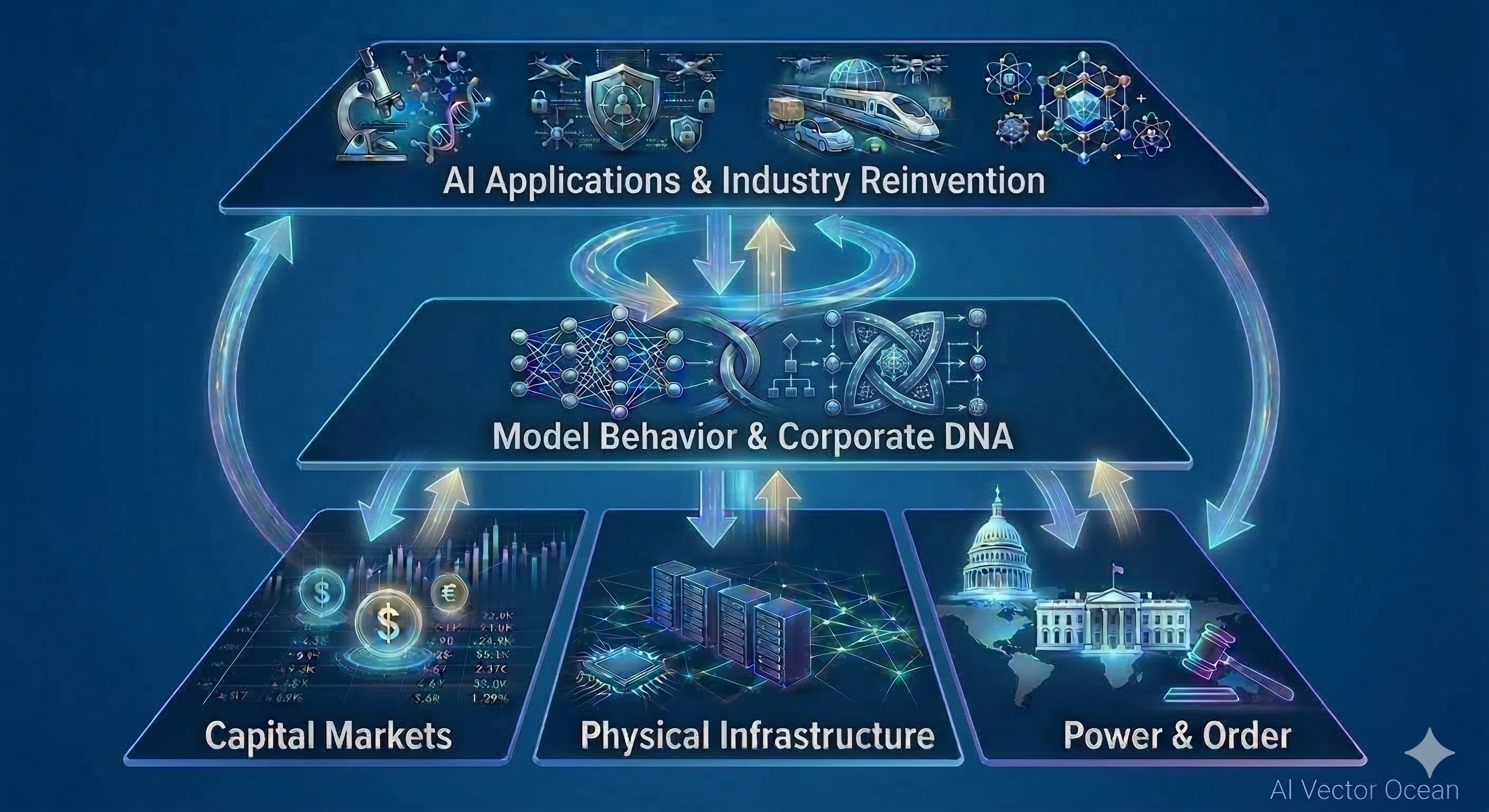
1. Model Behavior & Corporate DNA AI is not a static product. It is an evolving intelligence with distinct behavioral patterns — how it reasons, where it refuses, when it hallucinates, and why it complies. Understanding these patterns has direct implications for how you deploy, trust, and build around AI systems.
But model behavior is never purely a technical output. It is an expression of its creator’s balance sheet, funding structure, risk exposure, and strategic liabilities. The decisions that define how a model thinks, what it refuses, and where it draws its boundaries are downstream of corporate incentives — not just engineering choices.
This is not a stable relationship. As models grow more capable, they are beginning to reshape the corporations that built them — their competitive strategies, their organizational structures, and their valuations. Behavior and motive are inseparable. We analyze them together.
2. Capital Markets Capital is the fuel of the AI era. Building a frontier LLM is arguably the most capital-intensive infrastructure project in human history — and without it, none of the other layers move.
AI has simultaneously reshaped the markets that fund it. It has driven one of the longest bull runs in U.S. equity history and fundamentally altered how investors price technology, infrastructure, and intelligence itself. The capital that funds AI is being transformed by AI in return — in how it is raised, deployed, and valued.
We analyze this dynamic in both directions, because the boundary between AI as an asset and AI as a market force has already dissolved.
3. Physical Infrastructure The AI supercycle runs on chips, energy, data centers, and fiber. Each imposes real constraints on what is possible and when — no algorithm escapes the scarcity of atoms, and no investment thesis survives contact with infrastructure it ignores.
But AI is simultaneously transforming the infrastructure built to serve it. It is reshaping chip design, rewriting the economics of energy grids, and accelerating data center construction at a pace that is itself becoming a macroeconomic force.
What gets built today sets the ceiling for what AI can attempt tomorrow. We track where those ceilings are, and when they move.
4. Power & Order AI does not develop in a political vacuum. Domestic politics, regulatory regimes, geopolitical rivalries, and the social pressures of a world being restructured by automation — all of these actively shape which models get built, how they behave, and where they can operate. The values and restrictions hardcoded into models reflect political and social choices, not just technical ones.
But AI is simultaneously remaking the order that governs it. It is redrawing geopolitical fault lines, destabilizing regulatory frameworks that were never designed for it, reshaping the nature of electoral competition, and generating the kind of institutional friction — around labor, liability, and legitimacy — that rewrites rules. Distinct AI power spheres are emerging. Social resistance is building. The boundaries of what is politically and socially permissible for AI are being drawn in real time.
The fault lines forming here are not abstract. They will determine which AI strategies survive, which capital positions hold, and which competitive advantages prove durable. We map them before they become consensus.
5. AI Applications & Industry Reinvention AI is not simply a tool that industries adopt. It is becoming the foundational infrastructure upon which the next generation of every industry will be built — the substrate that connects raw computational intelligence to the specialized knowledge, workflows, and competitive logic of each sector.
In life sciences, AI is compressing drug discovery timelines and rewriting the economics of clinical development. In energy, it is optimizing grids and accelerating the design of next-generation systems. In finance, transportation, defense, and beyond, the pattern repeats: AI capability fused with domain expertise is producing outcomes that neither could reach alone. Agentic systems are pushing this further — not just augmenting human workflows but beginning to execute them autonomously.
This is the layer where the AI era’s economic value is actually created — and where the gap between AI’s potential and its current reality is most honestly measured. The specialized demands of each vertical are already shaping the next generation of models. We track that loop, because it is where durable advantage is built.
How We Work
The first step is signal extraction: identifying, within the daily volume of news and market noise, the developments that actually carry structural weight — the ones that shift constraints, alter incentives, or reveal something true about where the forces are moving. Most coverage fails here, not from lack of effort, but from lack of a framework capable of distinguishing signal from reaction.
From there, we apply structural analysis across the five layers — grounded in data where the numbers are legible, and in historical pattern recognition where they are not.
The Five Layers framework was not assembled from existing research. It was built from first principles, by someone who spent two decades watching how capital responds to structural change across cycles and geographies — and who identified AI as a generation-defining supercycle ahead of consensus, not as a prediction, but as a conclusion reached through that same analytical process.
We hold ourselves to the standards of institutional research in rigor and intellectual honesty. But we write to be read. The goal is analysis that transfers understanding, not documents that signal effort.
Our frameworks are built from deal experience, not from headlines. We do not follow the news cycle. We map the reality behind it.
Who We Serve
Investment professionals and allocators positioning across the AI and semiconductor value chain
Enterprise decision-makers navigating AI strategy, capital allocation, and competitive repositioning
Strategic operators who need to understand geopolitical and infrastructural constraints — not just benchmark headlines
Individuals operating at the intersection of professional responsibility and the AI transition — who require structural clarity, not surface coverage
Staying uninformed is not a neutral choice. It is a compounding disadvantage. Once it compounds, you rarely notice until the decision is already made.
